

Scratching Noises in Your Walls or Attic at Night? Here's What It Usually Is
That scratching over your bedroom ceiling at 11pm isn't the house settling. Here's how to tell what's up there from the timing and the sound — and what actually gets rid of it.
Scratching in walls or the attic at night in the San Gabriel Valley is usually roof rats — nocturnal climbers that reach rooflines by trees, ivy and utility lines. Night noise points to rats and mice; daytime noise points to squirrels or birds. Roof rats won't leave on their own, and poison backfires — the fix that lasts is trapping what's inside and sealing every opening.
On this page
In the San Gabriel Valley, scratching in the walls or attic after dark is usually one animal: the roof rat. They're nocturnal, they're superb climbers, and our mature trees, citrus, ivy and utility lines give them a highway straight onto the roofline. But the timing and character of the noise narrows it down fast — here's the field guide I run through on every one of these calls.
What the timing tells you
| What you hear | When | Most likely culprit |
|---|---|---|
| Scratching, gnawing, quick scurrying runs | Night — often within an hour of lights-out, again before dawn | Roof rats |
| Light, fast scratching near kitchen or lower walls | Night | Mice |
| Rolling or scampering sounds, heavier thumps | Daytime, especially early morning and late afternoon | Squirrels |
| Flutter, chirping, cooing from eaves or vents | Morning | Birds nesting |
| Slow, heavy dragging or thumping | Night | Opossum or raccoon (rare in tight attics) |
The rule of thumb: night noise points to rats and mice, day noise points to squirrels and birds. Rats also tend to run the same routes at the same times — people tell me they can nearly set a clock by it.
Confirming it's rats without going up there
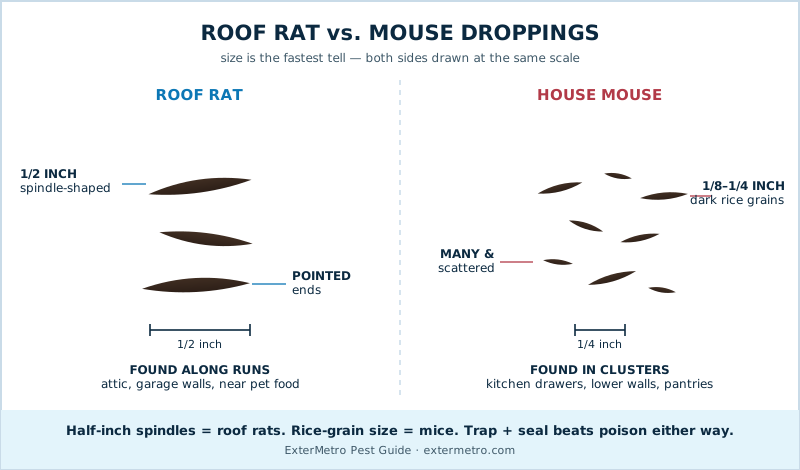
- Droppings — roof rat droppings are about half an inch long, spindle-shaped with pointed ends. You'll find them along garage walls, in the attic, or near pet food.
- Gnaw marks — fresh, pale tooth marks on wood, plastic bins, wiring insulation or irrigation lines. Rats gnaw constantly because their teeth never stop growing.
- Rub marks — greasy smudges along beams and entry holes from their fur.
- The neighborhood check — fruit trees with hollowed-out fruit, ivy-covered fences and pool equipment areas are classic roof rat territory. We wrote more about that in roof rats and citrus trees.
Why tossing poison in the attic backfires
It's the most common DIY move and the one I most wish people would skip. A poisoned rat usually dies somewhere you can't reach — inside a wall void or under insulation — and the odor that follows is memorable. California has also restricted many of the strongest rodenticides precisely because they move up the food chain to owls, hawks and pets. And poison does nothing about the actual problem: the openings the rats are using to get in.
What actually works
The fix that lasts is mechanical, not chemical: trap what's inside, seal every way in, and clean up what they left behind. Rats can squeeze through a gap the size of a quarter — attic vents with torn screens, gaps where cables enter, unscreened roof returns and lifted tile edges are the usual doors.
Sealing those (exclusion) is the difference between solving the problem and renting it back every winter. One caution before you touch anything up there: rodent droppings shouldn't be swept or vacuumed dry — read why, and what to do instead.
If the noise is nightly, it isn't going away on its own — colonies grow toward food, not away from it. A proper rodent inspection finds the entry points, and a trap-and-seal program with real follow-up ends it. Here are the exact entry points we check first.
Sources
And if something already died in there
If the smell showed up after somebody set bait, that's almost always what it is: a rodent died inside a wall void or under attic insulation where nothing can reach it. The odor peaks somewhere around the first and second week and fades over several weeks as the carcass dries out. There's no spray that ends it early.
What actually helps is locating it — tracing the strongest point along the wall, checking the attic run directly above, and opening the smallest access that reaches it. Once it's out, the space gets cleaned and disinfected. And then the openings still have to be closed, because whatever got in is how the next one gets in. That's the seal-up, and it's the half people skip.
Quick Answers
Quick Answers.
Why do I only hear scratching at night?
Rats and mice are nocturnal — they leave the nest to forage shortly after the house goes quiet and again before dawn. Daytime noises usually mean squirrels or birds instead.
Will the rats just leave on their own?
No. If they've nested in an attic with food and shelter nearby, the population grows. Roof rats breed several times a year, so a scratching sound in October is a bigger problem by January.
Can I just put poison up there?
You can, but a poisoned rat usually dies inside a wall or under insulation, and the smell lasts weeks. Poison also leaves every entry point wide open for the next family. Trapping plus sealing the openings is what lasts.
How do rats even get on my roof?
They climb — trees, ivy, fences and utility lines all work. Roof rats routinely travel power lines and drop onto rooflines, which is why trimming branches away from the roof matters.
Is it dangerous to clean the droppings myself?
Don't sweep or vacuum them dry — stirred-up dust from rodent droppings is how hantavirus exposure happens. Ventilate, wet everything down with disinfectant first, and read our hantavirus guide before you start.
How long does a dead rat smell last in a wall?
Usually two to four weeks, strongest in the first ten days or so, and longer in a cool wall void than in a hot attic. Air freshener and ozone machines cover it rather than end it. The only thing that ends it early is finding the carcass and removing it, then cleaning and disinfecting the spot. If bait was set anywhere in the house recently, that is almost certainly the cause, and the entry points are still open.
Keep Reading
About the Author
Joshua A. Westad is the owner and licensed operator of ExterMetro Termite and Pest Control in Arcadia, CA. He holds California SPCB Company Registration #8828 (Branch 2 & 3), is a licensed WDO inspector, and has worked San Gabriel Valley homes and businesses for over twelve years — hands-on in the field on every kind of job the valley throws at him.