
HOA & Community Pest Control
ExterMetro runs scheduled pest and termite programs for HOAs, condo associations and community management companies across the San Gabriel Valley. Boards get one predictable program per property — written notice for residents, board-ready service records after every visit, and clear guidance on association versus homeowner termite responsibility under Davis-Stirling. CA SPCB Reg. #8828 · (626) 409-1584.
Boards and community managers do not need another vendor to chase. They need pests handled on a predictable schedule, residents treated respectfully, and paperwork that makes the next board meeting easy. And when residents ask who is responsible for what, this plain-English guide to pest-control responsibility in California rentals settles it.
ExterMetro builds HOA programs around your property: common-area service on a consistent route day, clear protocols for in-unit requests, and direct communication with the same named licensed professional instead of a rotating cast of technicians.
If your community is dealing with ants, rodents, spiders or recurring resident complaints, request a proposal and we will walk the property with you.
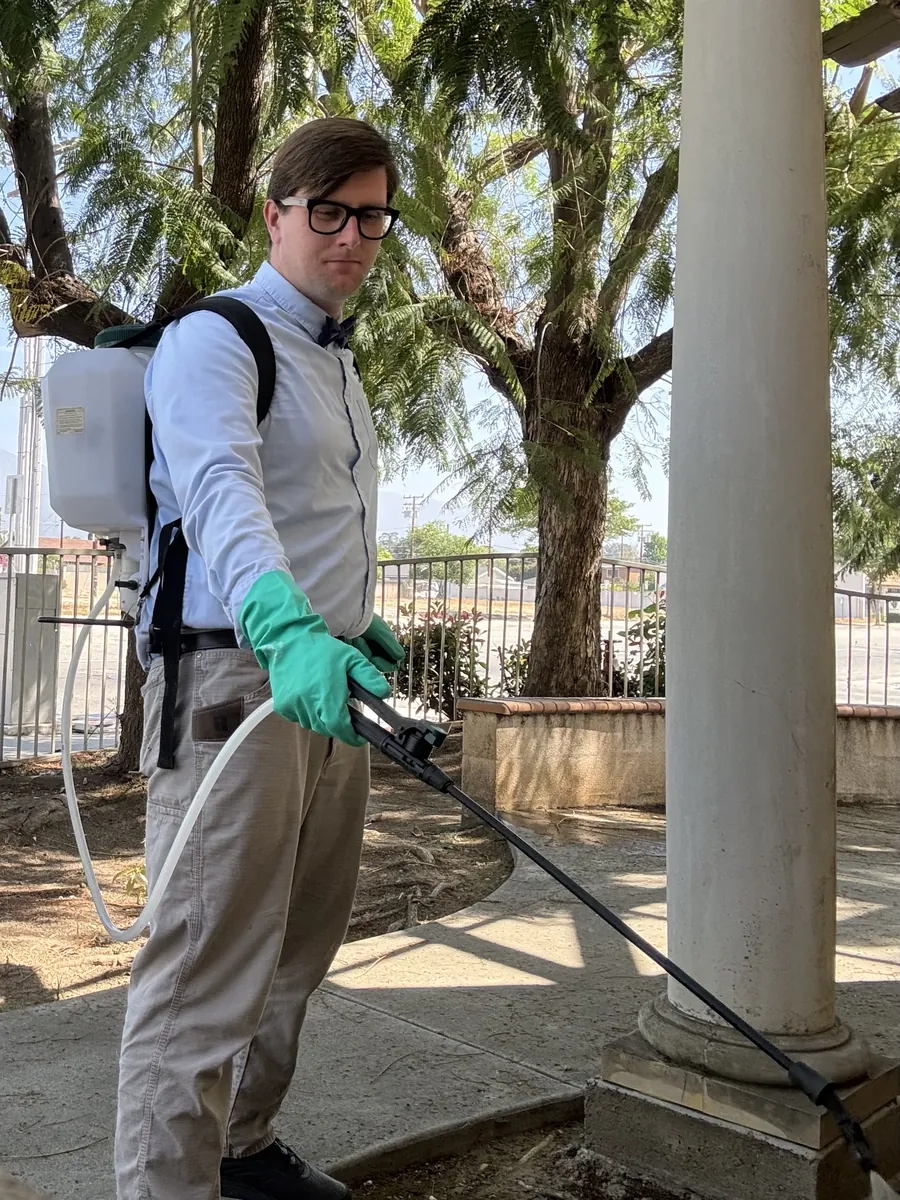
What You Get
- Common-area programsPerimeters, clubhouses, pools, mail areas and landscaping zones on a schedule that matches your community's pest pressure.
- Board-ready reportingService records and findings documented clearly, so management and the board always know what was done and why.
- Resident-friendly protocolsRespectful in-unit service with clear notice procedures, scheduled to minimize disruption.
- One point of contactYou deal directly with the owner. Questions reach ExterMetro directly, not a call center.
More Commercial Services
How The Program Works
Your HOA Program, Step by Step.
- Walk-through of common areas, trash enclosures, irrigation and problem units
- A written schedule the board approves — monthly, bi-monthly or quarterly
- Board-ready service reports after every visit
- The same named licensed professional on every visit, not a rotating route crew
HOA pest control fails when it is anonymous — a different technician each month, no paper trail, and residents who never know when service happened. Our program is the opposite: the same licensed owner walks your property every time, learns where the pressure comes from, and documents everything so the board can see what it is paying for.
Common-area service can be bundled with discounted in-unit treatments for residents, handled by the same person, on the same visit day.
Shared-Wall Communities
Townhomes, Condos & Duplexes.
Attached homes share more than walls — they share pests. Our HOA and community programs treat the whole envelope, not one unit at a time.
Do you service townhomes, condos and duplexes with shared walls?
Yes. Shared-wall homes — townhomes, condos, duplexes and fourplexes — are a core part of our HOA and residential work. Pests move through common walls and shared utilities, so the most effective approach treats the building envelope and common areas, not just one unit in isolation.
How do you handle pests that move between attached units?
By working the shared pathways — common walls, utility penetrations, attics and exterior perimeters — so pressure is controlled before it reaches the next unit. For HOAs and managed communities we coordinate timing and provide board-ready documentation.
Can you coordinate with an HOA board for approvals and notices?
Yes. We schedule around community needs, provide written notice and board-ready reporting after each visit, and keep the same named licensed professional on your account so communication stays consistent.
How do you bill an HOA or community — per unit or per property?
It depends on the community. For HOAs and managed properties we usually set up a single scheduled program priced to the property and scope, rather than billing unit by unit. After a walkthrough we'll lay out a clear, predictable structure the board can budget around.
How often should a community be serviced?
Most HOAs and communities do best on a recurring monthly or quarterly program, with common areas and trash enclosures checked most often. After walking the property we'll recommend a cadence that matches your pest pressure and budget — no overkill.
Who pays for termite treatment and damage in a California condo HOA?
Start with your CC&Rs — they control. If they are silent, California Civil Code 4780 makes the association responsible for repair and maintenance of the common area caused by wood-destroying pests in condominiums, community apartment projects, and stock cooperatives. In a planned development — most townhome communities — the default flips: each owner handles their own separate interest, though a majority of all members can vote to shift that duty to the association, which can then recover the cost as a special assessment. Confirm specifics with the association's counsel.
Can an HOA make residents leave their units for termite fumigation?
Yes. Under California Civil Code 4785, an association may cause the temporary removal of occupants when it is necessary for prompt, effective treatment of wood-destroying pests. Written notice must go to both occupants and owners not less than 15 days and not more than 30 days before the temporary relocation, and occupants are responsible for their own accommodations during the treatment. Boards should confirm the specifics with the association's counsel before sending notices.
Do termite bait stations work for townhome communities?
They are a strong fit for subterranean termites, the type bait stations are built for. In-ground stations ring the full perimeter of each attached building and any common-area structures, serviced on an annual cycle, so shared walls and lot lines stop mattering: the whole footprint sits inside one system. For a board, that means a predictable annual budget line instead of surprise assessments, one vendor accountable for the entire perimeter, and station-by-station monitoring records ready for the next meeting.
Does the HOA or the individual owner arrange the termite inspection?
It follows who holds responsibility. In condominiums and stock cooperatives, the association typically arranges inspections of common areas; in planned developments, owners usually arrange their own unless the CC&Rs or a member vote assign the duty to the association. Whoever orders it, the official wood-destroying organism report comes from a company licensed for Branch 3, and many boards order one inspection of the affected building so everyone works from the same document. ExterMetro holds Branch 3 and issues that report.
Can you complete our management company's vendor packet and credentialing?
Yes. Send the requirement schedule and it comes back completed, with the certificate of insurance issued by our agent directly to your office or credentialing platform and the additional insured endorsement form included rather than a certificate that only notes the status. Most schedules ask for the association and the management company both named, primary and non-contributory, and waiver of subrogation — send yours and you get a line-by-line answer. Registration #8828, Branch 2 and Branch 3.
Do you service multiple associations for one management company?
Yes, and communities get added as existing contracts expire rather than all at once. There is no second approval cycle for the second association — same registration, same endorsements, same agreement form, with its own scope, pricing line and service record. Nothing is bundled into a single agreement that would have to be unwound if one board goes a different direction.
How do your proposals and bid walks work for a board vote?
Proposals come back mirroring your RFP's own headings and line items so your scoring sheet fills itself in, with pricing broken out per building and per unit count rather than one campus number. Scope is written as plain-language inclusions and exclusions, and termite work is priced separately from general pest service. The licensed operator who would service the property is the one who walks it with you.
Who is legally required to notify residents before a pesticide application?
When an association applies pesticide itself without a licensed operator, California Civil Code section 4777 puts the notice duty on the association — generally 48 hours ahead, with common-area posting. When you retain a registered pest control company, the Structural Pest Control Act makes that written notice the company's obligation instead, naming the pest, the material and its active ingredients, and the label precautions. We deliver it ready to distribute.
How do work orders and invoicing flow with our software?
Work orders are updated and closed where you already look, with notes and photographs attached to the order. Invoicing is one invoice per property per service, referencing the work order number and uploaded at the time of service, so nothing has to be split across association ledgers at month end. Tell us which system your firm runs and the documents land there.
What documentation does the board get for meetings and renewals?
A written report every visit covering what was found, what was not found, what was done and what needs a board decision, broken out by building or address. Each community also gets a quarterly summary formatted to drop straight into a board packet: visits completed, findings by building, open recommendations with closeout dates, and the trend against the prior quarter.
Davis-Stirling, Plain English
Who Is Responsible for Termites in Your Community.
Termites do not read a parcel map. In a shared-wall building, the framing runs from one unit into the next, and so does the colony — which is exactly why California treats this as association business. The Davis-Stirling Act sets the default rules, and they split by community type.
The default under Civil Code 4780
- Condominiums, community apartment projects, and stock cooperatives: the association is responsible for repair and maintenance of the common area occasioned by wood-destroying pests or organisms — unless the declaration provides otherwise.
- Planned developments (most townhome communities): the default flips. Each owner is responsible for their own separate interest unless the declaration sets a different maintenance scheme. A majority of all members can vote to delegate that duty to the association, which may then recover the cost as a special assessment.
In every case, the declaration wins. If your CC&Rs assign termite responsibility differently, that language controls over the statutory default.
The powers boards actually use
Civil Code 4785 lets the association cause the temporary, summary removal of occupants when necessary for prompt, effective treatment of wood-destroying pests. Notice goes to occupants and owners not less than 15 days nor more than 30 days before the temporary relocation — and occupants cover their own accommodations. Civil Code 4777's pesticide-notice duties apply only when an association applies pesticide without a licensed pest control operator; when a licensed company performs the work, the written-notice duties in the Structural Pest Control Act apply instead — and we handle them.
Responsibility questions get resolved by an official finding, not a walkthrough with a flashlight. ExterMetro is licensed for Branch 3 — wood-destroying organisms — so our WDO inspections produce the official report a board can act on: the document that turns "someone saw swarmers in Building C" into line items your board, your manager, and your budget can work with.
The caveat that matters: none of this is legal advice. Declarations vary and amendments happen — have your association's counsel confirm how these sections apply to your community before you notice a relocation or levy an assessment.
One Structure, One Program
The Community Termite Program.
One owner treating one unit of a fourplex is theater. The colony is working the building, not the address — shared walls share termites, and the structure is the unit of treatment. Our community program is built around that fact.
Subterranean termites: bait the whole perimeter
We install in-ground bait stations around the full perimeter of attached buildings and common-area structures — clubhouses, pool buildings, mail kiosks — serviced on an annual cycle under our annual termite program, with targeted non-repellent spot treatments at active entry points. Stations work at the colony level and monitor year-round, with far less material in the ground than trenching every foundation. They also fit how associations actually run:
- A budget line, not an emergency: annual service is a predictable number the board approves once, not a surprise assessment mid-fiscal-year.
- One vendor for the whole perimeter: ExterMetro answers for every station around every building — no gap where two contracts meet, no vendor pointing at another vendor.
- Documentation for the minutes: every visit produces station-by-station monitoring records your manager can drop straight into the board packet.
Drywood termites: treat the structure that has it
Drywood colonies live inside the wood itself, so an infestation in one garage header does not obligate the whole community. Where the inspection supports it, a localized treatment handles the individual structure — accessible galleries treated directly, covered by our two-year treatment warranty.
Fumigation: the building tents as one
There is no tenting half a duplex. Shared walls, attics, and gas lines mean an attached building is fumigated as one structure — every household out on the same dates, the utility shutting off and restoring gas for the connected units together. That is board-level scheduling: relocation notices, keys, pets, utility windows, and re-entry all have to line up across multiple households at once. Our fumigation prep guide walks the full timeline, and we run the schedule so your manager is not chasing forty households one at a time.
Vendor compliance
The Vendor Packet, Already Assembled.
Approving a pest vendor is a document review before it is ever a service decision. The compliance coordinator is not evaluating termite methodology — they are checking whether the file is complete and current. Send your firm's requirement schedule and the packet comes back in the order your checklist asks for it.
| Packet item | How it arrives |
|---|---|
| Certificate of insurance | Issued by our agent directly to your office or credentialing platform, so it never passes through our hands |
| Additional insured endorsement | The endorsement form itself — CG 20 10 ongoing operations, CG 20 37 completed operations — not a certificate that merely notes the status |
| State licensing | Structural Pest Control Board registration #8828, Branch 2 and Branch 3, verifiable at the Department of Consumer Affairs |
| W-9 | One legal name, matched exactly to the agreement, the registration and every invoice |
| Workers' compensation | Certificate, or your signed exemption form executed and returned with the packet |
| Entity verification | Secretary of State status, active and in good standing |
| Signed agreement | Your paper or ours, one-year term where the governing documents cap it there |
Endorsement language is where most pest bids quietly die. Your schedule likely asks for the association and the management company both named as additional insured, primary and non-contributory wording, waiver of subrogation, and advance written notice of cancellation. Send the schedule and you get a line-by-line answer rather than a generic certificate. Worth raising early: standard general liability forms carry a pollution exclusion, which is why credentialing platforms often ask pest vendors for separate pollution coverage.
Portfolio onboarding
Adding Communities Without a Restart.
A management company does not onboard one association at a time, and neither do we. Start with the community that has the loudest problem. Add the next when a board votes, when an incumbent's term ends, or when a bid walk turns something up. There is no second approval cycle for the second property — same registration, same endorsements, same agreement form, with a new property record and a new scope sheet each time.
Each association keeps its own scope, its own pricing line and its own service record. Nothing is bundled into a single agreement that has to be unwound if one board decides to go a different direction.
Bid walks and proposals that actually compare
Boards are advised to collect at least three bids and score them on price, quality, experience, references and delivery. The complaint managers repeat is that the bids do not compare — three vendors describe three different scopes and the scoring sheet cannot be filled in without a phone call to each one. That is a formatting problem, and it is ours to solve rather than yours.
- Proposals come back in your RFP's own order, under your own headings, line item for line item.
- Pricing breaks out per building and per unit count rather than rolling into one campus number, so a board can see what removing the clubhouse or adding the rear carports does to the figure.
- Scope is written as inclusions and exclusions in plain language: which structures, which exterior areas, which pests, what frequency, and what triggers a return visit at what cost.
- Termite work is priced separately from general pest service, because they are separate decisions on separate calendars.
On the walk, the licensed operator who would actually service the property is the one walking it — through trash enclosures and their drainage, irrigation and grade at the slab, crawl areas and unit exteriors, not just the clubhouse and the office.
What reaches your desk
Complaints That Stop at the Property.
Across a portfolio, the real measure of a pest vendor is not the pitch — it is how many of the association's pest problems reach your desk at all. Most of them should not.
A named licensed operator is assigned to your communities and stays assigned. That person walks the same buildings, learns which trash enclosure drives fly pressure in July and which slab edge has produced subterranean activity twice, and is the person who answers when you call. There is no call center between you and the license, and no rotating route crew relearning the property every quarter. When you escalate, you escalate to the person who did the work.
How a resident complaint moves
- It arrives however you already work — your portal, your office, or the on-site manager.
- It is scheduled into a firm arrival window rather than an all-day block, so nobody is fielding "when are they coming" calls.
- The finding is written down whether or not activity was present, because "we sent someone and never heard back" is what puts a vendor into a scorecard review.
- The work order closes with notes and photographs attached, in a form you can forward to a board member without rewriting it.
Residents get a working phone line rather than your inbox. You get the outcome.
Board packet ready
Records That Are Already in the File.
One invoice per property, per service, referencing the work order number and uploaded at the time of service in whatever system your firm runs. No month-end bundle for accounting to split across five associations' ledgers, and no duplicate arriving three weeks later against the wrong entity.
Each community gets a quarterly summary written for a board packet: visits completed, findings by building, recommendations issued with their closeout dates, and how the trend compares to the prior quarter. When a vendor scorecard comes around at renewal — quality, responsiveness, communication, contract compliance — the evidence is already in the file, and nobody is reconstructing a year of service from memory the week before the meeting.
The notification obligation sits with us
This one is worth understanding precisely, because it is commonly misread. California Civil Code section 4777 places a notice duty on an association that applies pesticide to a separate interest or common area without a licensed pest control operator — individual notice at least 48 hours ahead, plus posting in the common area where practicable. Retaining a registered company changes who carries that burden: under the Structural Pest Control Act, the written notice to the owner or the owner's agent and to the tenant becomes our obligation, naming the pest, the material and its active ingredients, and the label precautions.
You receive it in a form you can actually send — mailing copy formatted for resident distribution, posting copies for common-area entries, scheduled dates and the material information in one document. Nothing for your staff to retype, and nothing to chase us for on the morning it is due.
What HOA Communities Deal With
Common areas, shared pressure
Pools, clubhouses, trash enclosures and landscaping draw pests that affect every resident. A community program covers these shared spaces, not just individual units.
Pests ignore unit lines
In attached homes, ants, roaches and rodents travel common walls and utility chases. Controlling them means treating the building envelope and shared pathways together.
Boards run on documentation
HOA boards and managers answer to residents and to records. Each visit comes with board-ready reporting on what was treated and found, ready for meetings and budgets.
Need a reliable commercial vendor?
Walk-throughs and proposals are free. A named licensed professional, accountable start to finish.