
The San Gabriel Valley Termite Evidence Guide
Every sign termites leave behind, what each one actually means, what it is commonly mistaken for, and what it leads to. Written for homeowners who found something on a windowsill last night and want a straight answer before anyone quotes them anything.
Two termites matter in the San Gabriel Valley and they leave completely different evidence. Drywood termites live inside the wood and push hard, six-sided, ridged pellets out through kickout holes smaller than two millimetres, leaving small piles below the infested member. Subterranean termites live in the soil and build pencil-width mud tubes from the ground up to the wood, and their damaged wood is packed with soil rather than clean. Shed wings mean a colony nearby released swarmers. Fine flour-like powder with round pinholes is a wood-boring beetle, not a termite, and crumbling cube-shaped wood is fungal decay. Which sign you have decides the treatment, so identification always comes before a quote.
A complete field guide to termite evidence in San Gabriel Valley homes — drywood pellets and kickout holes, subterranean mud tubes, swarmers and shed wings, damage patterns, look-alikes, and a month-by-month swarm calendar. Published by ExterMetro, a licensed California termite company. CA SPCB Reg. #8828 · (626) 409-1584.
Almost nobody finds a termite. What people find is what termites leave behind — a small pile of grit on a sill, a line of identical wings by the slider, a ridge of dried mud running up the stem wall, a patch of paint that ripples like there is water under it. This guide is the whole catalogue of that evidence, and, just as importantly, the catalogue of things that look like it and aren't.
Start here with the map, then read the section that matches what you found.
| What you found | What it means | Where it leads |
|---|---|---|
| Small pile of hard, uniform six-sided pellets with lengthwise ridges | Drywood termite frass, pushed out of infested wood directly above the pile | Localized no-tent treatment when the activity is limited and accessible |
| Pinhead-sized round holes in wood, under two millimetres, often with grit below | Drywood kickout holes — the openings the pellets came through | The kickout hole, not the pile, is where the colony is. Inspection traces it |
| Pencil-width tube of dried mud climbing a foundation, pier or slab edge | Subterranean termites travelling between the soil and your wood | In-ground bait stations plus targeted entry-point treatment |
| Damaged wood packed with soil and dark staining | Subterranean galleries — they carry soil in with them | Bait stations plus correcting the moisture that fed it |
| Damaged wood that is clean and hollow, with smooth chambers | Drywood galleries — no soil, because they never leave the wood | Localized treatment, or fumigation if widespread |
| Piles of identical shed wings on sills, in webs, or by doors | A colony nearby swarmed; the wings are what the reproductives drop | Inspection to identify the species and find the colony |
| Paint or veneer that blisters and ripples with no water source | Galleries eaten right up to the surface film | Inspection — sounding and probing confirms it |
| Wood that sounds hollow or papery when tapped | Possible internal galleries, or possible decay | Inspection — this one genuinely cannot be called from a photo |
| Fine, flour-like powder with round exit holes | Wood-boring or powderpost beetles, not termites | Identification first; the treatment is different |
| Coarse, fibrous shavings with insect parts mixed in | Carpenter ants excavating wood, not eating it | Ant control, plus finding the moisture that softened the wood |
| Wood crumbling into brown cubes, often damp | Fungal decay (dry rot) — a moisture problem, not an insect | Inspection; it belongs on the report as a condition |
Drywood Termite Evidence, in Detail
Drywood termites fly to a house, find a crack or an exposed end-grain, and move into the wood itself. They need no contact with soil and no external moisture, which is why they thrive in exactly the parts of a San Gabriel Valley home that bake all afternoon: rafter tails, fascia, barge boards, window and door frames, garage door headers, patio-cover beams, and attic framing.
Fecal pellets (frass)
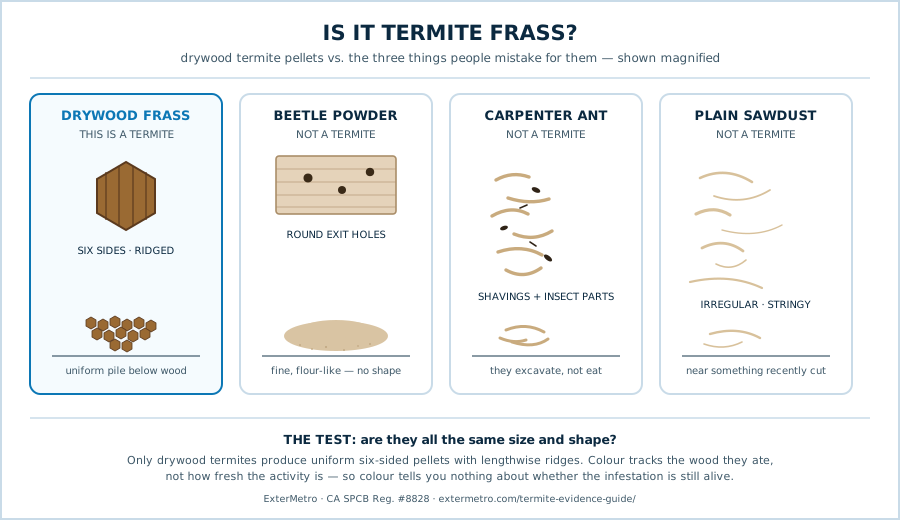
This is the single most common first sign. Drywood termites keep their galleries clean by pushing waste out, and the waste is distinctive: hard pellets roughly a millimetre long, with six flattened sides and clear lengthwise ridges. That six-sided shape is diagnostic — it is the feature that separates drywood frass from almost everything else. Colour runs from cream through tan to near-black and tracks the wood they ate, not how fresh they are, so colour tells you nothing about whether the infestation is active.
The pellets collect in a small conical pile on whatever flat surface sits below the wood: a sill, a baseboard, a garage floor, a patio slab, the top of a stored box in the attic. Move the pile and look up.
Kickout holes
Directly above a pellet pile there is usually a kickout hole — a round opening in the wood, typically less than two millimetres across, that the termites use as a waste chute and then reseal. Finding the hole matters far more than finding the pile, because the pile only proves that something happened; the hole tells an inspector which member the colony is living inside. On painted trim they are easy to miss, and they are often mistaken for nail holes or stucco weep holes.
Blistered or rippled paint and veneer
When a gallery is eaten right up to the surface, the paint film or veneer left over it loses its backing and starts to ripple, blister, or dish inward. It looks like water damage, and people usually check the roof first. If there is no plausible water source and the wall or fascia is otherwise dry, it is worth having the wood sounded.
Hollow-sounding wood
Tapping along a piece of trim or framing, a member with galleries inside returns a papery, drum-like note instead of a solid one. This is what inspectors mean by sounding, and it is one of the two things a real inspection does that a walk-by does not. The other is probing — pressing a tool into suspect wood to find where the surface gives.
Swarmers and shed wings
Western drywood termites swarm during daylight hours in summer and fall, most noticeably on hot afternoons and often as a heat wave breaks. The swarmers themselves are short-lived; what stays behind is a scatter of identical, equal-length wings, usually along a windowsill, in a spider web, or by a door where they were drawn to the light. A swarm outdoors in the San Gabriel Valley is ordinary. A swarm indoors, or wings on an interior sill, means a mature colony is already inside the structure and is now producing its next generation from your framing.
One honest caveat, straight from the University of California: pellets alone cannot tell you whether an infestation is currently active, or how far it extends through a piece of wood. That takes an inspection.
Subterranean Termite Evidence, in Detail
Subterranean termites are a different animal in every practical sense. The colony lives in the soil, often extending well past your property line, and only the foraging workers commute up into the structure. They cannot survive in open, dry air, so everything they build is about staying enclosed and humid — which is why their evidence is made of mud.
Mud tubes, and the four kinds
A mud tube is a covered runway of soil and saliva, usually about the width of a pencil, running along foundations, stem walls, piers, slab edges, and the inside of crawl-space walls. Entomologists distinguish four kinds, and the difference is genuinely useful:
- Working tubes run from the soil to the wood and carry traffic. These are the ones that matter most.
- Exploratory or migratory tubes rise from the soil but connect to nothing — foragers prospecting upward and finding no food.
- Drop tubes hang down from infested wood back to the soil, built from above rather than below.
- Swarm tubes are wider, temporary exit points built so winged reproductives can launch.
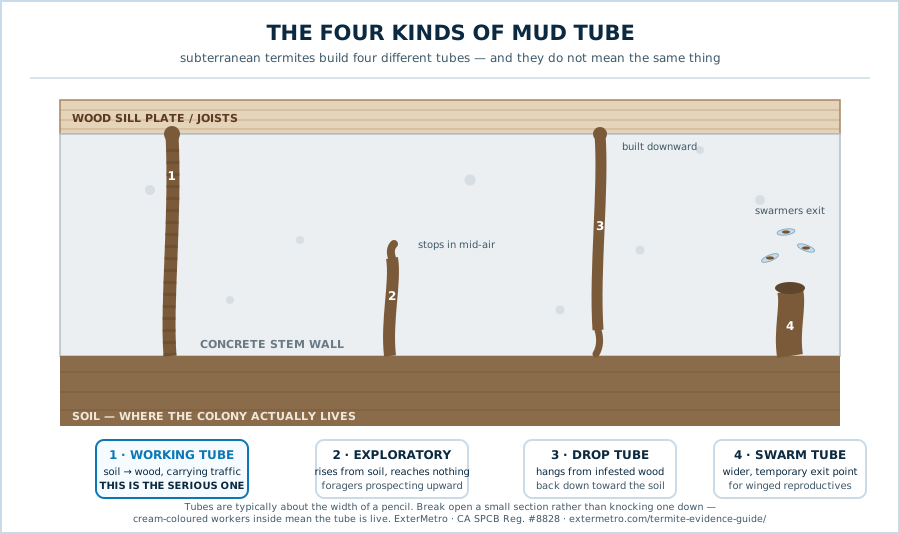
To test one, break open a small section rather than knocking the whole thing down. Cream-coloured workers inside mean the tube is live. An empty, crumbling tube may be abandoned — or may simply be a rerouted section, which is why removing all the evidence before an inspection is a bad idea.
Soil-packed damage
Where drywood galleries are clean and smooth, subterranean galleries are dirty. Workers bring soil in with them, so damaged wood is streaked and packed with mud and often smells earthy. If you break open a piece of damaged framing and it is full of dirt, you are not looking at a drywood problem, and no tent will fix it.
Swarmers after rain
Western subterranean termites swarm during the afternoon in spring or fall, on clear days after a soaking rain, with spring the most commonly noticed. Because most soil around a house contains buried cellulose — roots, old stumps, forgotten fence posts — a swarm in the yard does not by itself prove the house is infested. A swarm emerging from inside the structure does.
The conditions that invite them
Subterranean pressure is largely a moisture story, and in a heavily irrigated valley that matters. Sprinklers hitting stucco every morning, downspouts discharging at the foundation, planter beds built up above the slab line, wood fencing or posts set directly into soil against the house, stored firewood or lumber on bare ground, and crawl spaces with poor ventilation all raise the odds. These are conditions, not infestations, but they belong on any honest inspection report.
What It Probably Isn't: The Look-Alikes
A large share of what gets texted in as termite evidence turns out to be something else. That is good news for the homeowner and worth knowing before anyone sells you a treatment.
Wood-boring and powderpost beetles
These leave fine, flour-like powder and round exit holes in the wood surface. Under any magnification the powder is dust, not pellets — no six sides, no ridges. Beetle activity is a real wood-destroying-organism finding and belongs on a report, but it is treated differently from termites.
Carpenter ants
Carpenter ants excavate wood to nest in it; they do not eat it. What they push out is coarse and fibrous, like miniature pencil shavings, and characteristically contains bits of dead insects. Their galleries are smoothly sanded and clean. Carpenter ants almost always mean wood that got wet first, so the ant is a symptom.
Dampwood termites
Dampwood termites also make pellets, but theirs are elongated and rounded at both ends — football-shaped — and lack the crisp lengthwise ridges of drywood pellets. They also swarm in summer and fall, and unlike drywood swarmers they are strongly drawn to lights after dark. They need genuinely wet wood, so finding them points at a leak.
Fungal decay, or dry rot
Decayed wood crumbles into brown cubes, darkens, and often smells musty. There are no galleries and no pellets, because nothing is eating it — a fungus is breaking it down, and the fungus needs sustained moisture. This is one of the most common findings on California inspection reports and one of the most commonly mistaken for termite damage.
Ordinary sawdust and construction debris
Sawdust is irregular and stringy, with fibres of varying length, and it is usually near something that was recently cut or drilled. Drill dust from a picture hook or an anchor is a frequent false alarm.
Rodent droppings
From across a garage, mouse droppings and a frass pile can look similar. Up close they are not: rodent droppings are several times larger, cylindrical with pointed ends, soft when fresh, and they do not have flat facets. If that is what you have, the relevant page is rodent control.
Mud dauber nests
Mud daubers are wasps that build mud cells stuck flat against a wall, a ceiling, or under an eave — either an irregular lump of packed mud or, in the organ-pipe species, a row of parallel vertical tubes. They are made of mud, but they do not run in a narrow line between the soil and the wood the way a termite tube does. Direction and shape are the giveaway.
Where to Look, Area by Area
If you want to check your own house before calling anyone, this is the route a licensed inspector takes, in order. Bring a flashlight and hold it at a low angle to the surface — raking light shows kickout holes and rippled paint that flat light hides.
Exterior and eaves
Walk the full perimeter and look up. Rafter tails, fascia, barge boards, the underside of eaves, exposed beam ends, patio covers, wood trellises, window and door frames, and any painted wood that meets stucco. Then look down: the foundation line, the stem wall, hose bibs, and the strip of soil against the house.
Garage
Garages give up more evidence than any other part of an SGV house, because the framing is often exposed. Check the door header and jambs, the bottom plate where framing meets the slab, the slab edge, and the floor along the walls for pellet piles.
Interior
Windowsills first, especially the ones that catch afternoon sun. Then baseboards, door casings, hardwood floors near exterior walls, and any wood that has started to stick, sag, or sound different underfoot.
Attic
Where there is access, look at the rafters and the top plate, and check the top of the insulation and stored boxes for pellets that fell from above. Attics are also where old, treated damage often shows, which is why a report should distinguish active from historic.
Subarea and crawl space
Piers, girders, joists, and the soil surface itself. This is where mud tubes are most often found and where moisture conditions are read: standing water, damp soil, poor ventilation, and any point where earth meets wood.
Anywhere you cannot get to — a sealed wall, a furniture-blocked closet, a crawl space too tight to enter — is genuinely unknown, and a report should say so rather than guess. That single line is one of the fastest ways to judge whether an inspection was real.
When Termites Show Themselves in the San Gabriel Valley
Evidence can be found in any month, because pellets and tubes do not keep a calendar. Swarms do. This is the rhythm here.
| Season | What tends to happen | What to watch for |
|---|---|---|
| Winter (Dec–Feb) | Quiet above ground; subterranean colonies stay active in the soil, and rain drives moisture against foundations | Mud tubes appearing on stem walls and piers; damp subareas |
| Spring (Mar–May) | Peak subterranean swarming — clear afternoons after a soaking rain | Daytime swarms in the yard or, more seriously, emerging from inside the structure |
| Early summer (Jun–Jul) | Ant season begins; termite evidence accumulates quietly | Fresh pellet piles rebuilding after you sweep them away |
| Late summer (Aug–Sep) | Drywood swarming begins, in daylight, often as a heat wave breaks | Identical shed wings on sills, in webs, and by doors |
| Fall (Oct–Nov) | Peak drywood swarming continues; subterranean swarms possible again after the first rains | Swarmers indoors — the sign that most often turns into a same-week inspection |
The practical consequence of that calendar is simple: a house here faces new drywood swarmer pressure every single year, whatever was treated last year. That is the entire argument for an annual re-inspection rather than waiting for the next pile of pellets to appear.
What to Do the Moment You Find Something
- Do not spray it. Over-the-counter sprays rarely reach a colony, and they destroy the evidence an inspector needs to identify the species. This is the single most common mistake.
- Photograph it in place, with something for scale. A coin or a fingertip in the frame makes the difference between a guess and an answer. Take one close-up and one wider shot showing the wood above.
- Bag a small sample. A few pellets or a few wings in a zip-top bag, kept dry.
- Write down where and when. Which room, which side of the house, what date. If you want to test whether it is active, sweep the pile away completely, note the date, and check the same spot in a week or two — drywood termites keep pushing pellets out, so a pile that rebuilds means live activity, while ordinary building vibration can shake a few loose from an old gallery.
- Get it identified before anyone quotes a treatment. Text a photo to (626) 409-1584 for a free read, or book a termite inspection so somebody sounds and probes the actual wood and puts the findings in writing.
Then let the evidence pick the treatment, not the other way around. Pellets and kickout holes point to localized no-tent treatment when the activity is limited and accessible, and to fumigation when it is genuinely widespread — the full comparison is here. Mud tubes point to in-ground bait stations and targeted entry-point work, and no tent touches those. If you are still not sure which you are looking at, the termite control page lays out all three methods side by side.
Quick Answers
Quick Answers.
What do drywood termite droppings look like?
They are hard pellets roughly a millimetre long with six flattened sides and clear lengthwise ridges, which is what makes them diagnostic. Colour ranges from cream to near-black and follows the wood the termites ate, not how recent the activity is. They collect in small conical piles directly below the infested wood, on sills, baseboards, garage floors, patio slabs, or the top of attic insulation.
How can I tell termite frass from sawdust?
Uniformity. Frass pellets are all about the same size and shape, with flat facets and ridges. Sawdust is irregular and stringy, with fibres of different lengths, and it is usually near something recently cut or drilled. Fine flour-like powder with round exit holes is a wood-boring beetle rather than a termite, and coarse fibrous shavings containing bits of dead insects are carpenter ants.
What does a termite mud tube look like?
A tube of dried soil and saliva, usually about the width of a pencil, running up a foundation, stem wall, pier, slab edge, or crawl-space wall. It is a covered runway that lets subterranean termites travel from the soil to wood without drying out. Working tubes connect soil to wood; exploratory tubes rise from the soil and connect to nothing; drop tubes hang from infested wood back down to the ground.
How do I know if termite evidence is active or old?
For drywood pellets, clean the pile up completely, note the date, and check the same spot a week or two later — an active colony keeps pushing pellets out of its kickout hole, while ordinary building vibration can shake a few loose from a gallery that is long dead. For a mud tube, break open a small section: cream-coloured workers inside mean it is in use, and an empty crumbling tube may be abandoned. Neither test replaces an inspection, because pellets alone cannot show how far an infestation extends.
Do shed wings mean I have termites in my house?
They mean a colony swarmed nearby. Wings found outdoors are common in the San Gabriel Valley and do not prove your structure is infested, because there is buried cellulose in almost every yard. Wings on an interior windowsill, in an indoor spider web, or by a door inside the house are a different matter — that usually means a mature colony inside the structure released its reproductives, and it is worth an inspection promptly.
When do termites swarm in Southern California?
Western drywood termites swarm during daylight hours in summer and fall, most noticeably on hot afternoons. Western subterranean termites swarm in the afternoon in spring or fall, on clear days following a soaking rain, with spring the most commonly noticed. Dampwood termites also swarm in summer and fall but are drawn to lights after dark, which drywood swarmers generally are not.
Is it termite damage or dry rot?
Decayed wood crumbles into brown cubes, darkens, and often smells musty, with no galleries and no pellets, because a fungus is breaking it down rather than an insect eating it. Termite damage leaves chambers: clean and smooth for drywood, soil-packed and streaked for subterranean. The two frequently occur together, because the moisture that feeds the fungus also attracts subterranean termites, so a report should list both separately.
Should I knock down a mud tube I found?
Break open a small section to see whether workers are inside, but leave the rest. Removing the whole tube destroys the map of where termites are entering, and they simply rebuild — often along a route nobody has seen yet. The same logic applies to pellet piles and shed wings: photograph them, bag a sample, and leave the scene readable for whoever inspects it.
Can you identify termites from a photo?
Often, yes, for the species question — six-sided ridged pellets, a mud tube, or a set of equal-length shed wings are usually recognisable in a clear close-up with something for scale. What a photo cannot do is tell you how far the activity extends or whether there is a second infestation elsewhere, which is what decides the treatment. So a photo is a good free first step and a poor substitute for an inspection. Quotes from photos are free.
What if I find both pellets and mud tubes?
Then the house has both termites, which happens often enough in the San Gabriel Valley to be unremarkable. They are separate problems with separate treatments and they do not interact: the drywood side is treated in the wood, by localized injection or fumigation depending on spread, and the subterranean side is treated in the soil with bait stations and targeted entry-point work. Both should appear on the same written report, and both should be quoted line by line.
Sources and Further Reading
The identification details on this page follow the published entomology rather than house opinion. The primary references:
- UC IPM: Drywood Termites — the University of California Statewide Integrated Pest Management Program on drywood identification, six-sided fecal pellets, kickout holes under two millimetres, and swarm timing.
- UC IPM: Subterranean and Other Termites — shelter tube types, swarm behaviour after rain, dampwood termite comparison, and moisture conditions.
- NPMA Pest Guide: Termites — the National Pest Management Association's general species reference.
- California Structural Pest Control Board — what a California wood-destroying organisms report must contain, and who is licensed to write one.
- SPCB Activity Report Search — the public record of WDO reports and completion notices filed on a given address.
- DCA License Search — verify any California pest control license, including ours: CA SPCB Reg. #8828.
This guide is free to reference and link to. If it is useful to your neighbourhood association, your property management office, or your own site, you are welcome to cite it.
About the Author
Joshua is the owner and licensed operator of ExterMetro Termite and Pest Control in Arcadia, CA. He holds California SPCB Company Registration #8828 (Branch 2 & 3), is a licensed WDO inspector, and has worked San Gabriel Valley homes and businesses for over twelve years — hands-on in the field on every kind of job the valley throws at him.
Found something and want a straight answer?
Photograph it in place, bag a small sample, and text the picture to (626) 409-1584 — quotes from photos are free, and your job stays under licensed ExterMetro oversight from inspection through follow-up.