
Rats & Mice in the San Gabriel Valley
The San Gabriel Valley's rodents are mostly roof rats and house mice. Here's how to identify them — and why traps alone never quite work.
- Roof rats: agile climbers, nest high (attics, trees)
- Norway rats: bigger, ground and burrow dwellers
- House mice: small, grey-brown, big ears
- Droppings, gnaw marks, scratching at dusk
- Roof rats love citrus and fruit trees
What they look like
The San Gabriel Valley's most common rat is the roof rat — a sleek, agile climber (6–8 inch body plus a longer tail) that nests up high. Norway rats are heavier and stockier, prefer ground level and burrows, and turn up less often here. House mice are small and grey-brown with oversized ears and a thin tail.
All three leave droppings and gnaw marks, but where you find them tells you which you've got: high and climbing points to roof rats, low and burrowing to Norway rats.
Roof rat vs. Norway rat vs. house mouse
| Feature | Roof rat | Norway rat | House mouse |
|---|---|---|---|
| Adult size | 6–8 in body, long tail | 7–10 in body, stocky | 2–4 in body, small |
| Where they nest | High: attics, trees | Low: burrows, ground | Clutter near food |
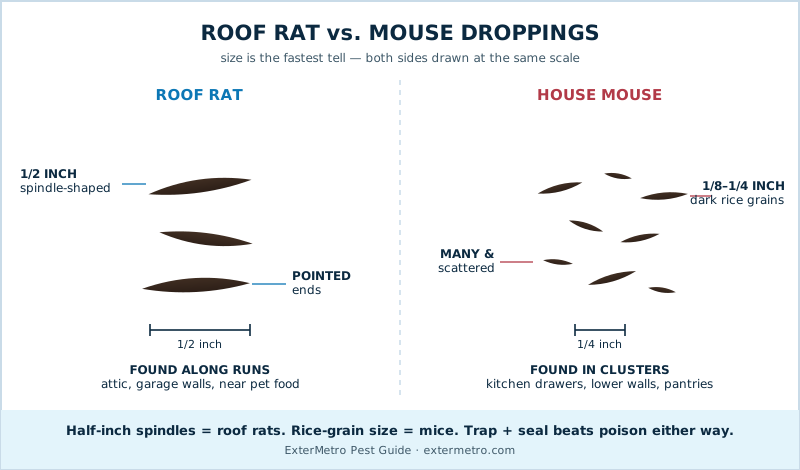
| Droppings | Pointed, ~1/2 in | Blunt, ~1/2–3/4 in | Tiny, rice-grain size |
| Climbs / diet | Excellent climber; fruit | Ground-based; varied | Climbs; nibbles widely |
Where they live
Roof rats treat tree branches, fences, wires and vines as highways to your roofline, then nest in attics, garages and wall voids. In the SGV that makes fruit and citrus trees one of the biggest draws — a backyard orange or avocado tree is both a food source and a ladder.
Mice need very little: a quiet, cluttered corner near food — a garage shelf, a pantry, behind appliances — is enough. They nest in stored boxes, insulation and rarely-moved clutter.
Signs of a rodent problem
Watch for droppings in the garage, pantry or under sinks; gnaw marks on packaging, wood, wiring and irrigation lines; greasy rub-marks along walls; and scratching or scurrying overhead at night — roof rats are mostly nocturnal, peaking after dusk and before dawn. A musky smell often builds as numbers grow.
One word of caution: don't sweep or vacuum droppings — that can put particles into the air. Our hantavirus guide walks through what to do instead.
How rodents are controlled
Trapping clears the rodents already inside, but on its own it never quite finishes the job — more simply follow the same routes in. Lasting control depends on exclusion: physically sealing every gap wider than about 1/4 inch, trimming the limbs and vines that bridge to the roof, and cleaning up attic nesting. The entry points we check first shows exactly where they get in.
Our rodent control pairs trapping with that exclusion work and attic cleanup, so the population can't simply refill.
Related Pests
Quick Answers
Quick Answers.
How do I tell rats from mice?
Rats are much larger, with thicker bodies and tails; mice are only a few inches long with oversized ears and thin tails. Roof rats nest high in attics and trees, while mice nest low in cluttered spots near food.
Why don't traps alone get rid of rats?
Trapping removes the rats currently inside, but more follow the same entry points within days. Lasting control requires exclusion — sealing every gap wider than about 1/4 inch — not just trapping.
Why do I have roof rats if I have citrus trees?
Roof rats feed on fruit and use tree branches as elevated highways to your roofline and attic. In the San Gabriel Valley, backyard citrus and avocado trees and roof rats very often go together.
Can I clean up rodent droppings myself?
Avoid sweeping or vacuuming them, which can send particles into the air. Ventilate the area, keep people and pets out, and follow our hantavirus guide — or have the cleanup handled professionally.
How are rats and mice getting into my house?
Rats can fit through a gap about 1/2 inch wide, and mice through one as small as 1/4 inch. Common routes are roofline and eave gaps, utility and pipe penetrations, garage-door corners, and vents — which is why sealing entry points matters so much.
How quickly do rodents multiply?
Fast. A single pair can become dozens within months under good conditions, since females can produce several litters a year. That's why a small problem caught early is far easier to control than one left to grow.
Dealing with rats & mice?
Free quotes, honest answers, and licensed service that follows through.