

How to Get Rid of Mice in the House: Trap and Seal Together
A mouse in the kitchen is almost never alone, and it rarely came from far away. Here is the method that ends it: enough traps, set right, while the quarter-inch gaps get sealed with metal.
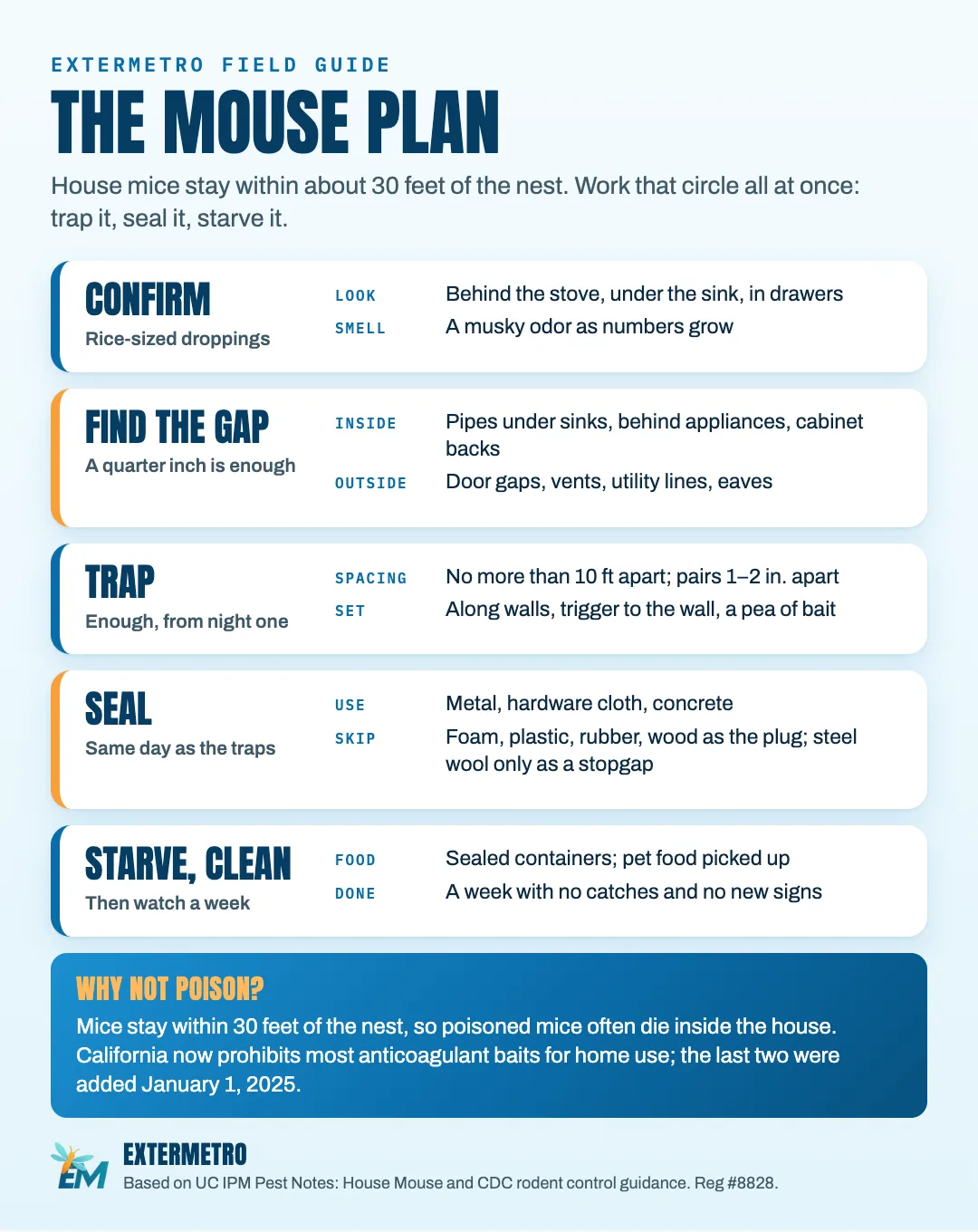
To get rid of mice, trap and seal at the same time: set enough mouse-sized snap traps along the walls where you find droppings, no more than about 10 feet apart, while you close every gap larger than a quarter inch with metal or concrete. House mice seldom travel more than 30 feet from their nest, so the opening is usually close to the evidence. Take away the food and the shredded-paper nesting spots, clean up droppings without sweeping or vacuuming, and keep the traps out until a week passes with no catches and no new signs. Poison is a poor fit indoors: a mouse that eats it often dies somewhere inside the house, and California now prohibits most anticoagulant rodenticides for home use.
Local help: We trap and seal in the same visit, with a one-year warranty on the exclusion work. Call or text (626) 409-1584 or get a free quote.
On this page
- How to get rid of mice: the 7-step method
- Mouse, young rat or deer mouse? Check before you buy traps
- Where mice get in: the quarter-inch rule
- How to trap mice so it works the first week
- Seal with metal, at the same time as the traps
- Take away the food and the nesting spots
- Why mouse poison backfires, and what California changed in 2025
- What does not get rid of mice
- Cleaning up mouse droppings and nests
- How long does it take to get rid of mice?
- When to call a mouse exterminator, and what the visit includes
- Sources
- Quick answers
How to get rid of mice: the 7-step method
To get rid of mice, work the 30-foot circle around the nest all at once: confirm what you have, find the openings, set enough traps, seal the gaps the same day, take away the food, clean up, and keep checking for a week. UC IPM calls exclusion the most successful and permanent form of house mouse control and trapping the preferred way to remove the mice already inside a home when only a few are present. Doing both at the same time is what keeps the kitchen from refilling.
- Confirm it is mice. Rice-sized droppings with pointed ends, scratchy gnaw marks, shredded-paper nests and a musky smell. A young rat has a proportionately bigger head and feet.
- Find the openings. Mice squeeze under a quarter-inch gap, about the width of a pencil. Check pipes under sinks, behind appliances, cabinet backs, door and vent gaps and utility lines.
- Set enough traps the first night. Mouse-sized snap traps along the walls where the droppings are, no more than about 10 feet apart, trigger to the wall, a pea of bait, set lightly.
- Seal at the same time. Close every gap larger than a quarter inch with metal, hardware cloth or concrete. Foam, plastic, rubber and wood get chewed when used as the plug; steel wool is only a stopgap.
- Take away the food and the nests. Dry goods in sealed containers, pet food picked up overnight, garbage lidded, clutter and paper cleared, plants off the walls.
- Clean up without stirring up dust. Air the room out for 30 minutes, wet droppings with disinfectant, let them soak five minutes, and wipe them up with paper towels into a covered trash can; dead mice and nests get double-bagged. Never sweep or vacuum them.
- Keep the traps out a week past the last catch. A week with no catches and no new droppings or gnawing means the house is clear and the seal-up is holding.
Mouse, young rat or deer mouse? Check before you buy traps
An adult house mouse is 5 to 7 inches long including a 3- to 4-inch tail, weighs about half an ounce, and is light brown to gray with large ears, small black eyes and a nearly furless tail. Two look-alikes change the plan. A very young roof rat has a large head and feet in proportion to its body and means there are rats, which call for rat-sized traps (UC IPM notes the smallest juveniles may not set one off); UC IPM’s seal-up standard is a quarter inch for rats and mice alike. A deer mouse, the species UC IPM calls the principal reservoir of Sin Nombre virus, a hantavirus that causes hantavirus pulmonary syndrome, has a white belly and a two-tone tail, dark on top and white underneath.
| Feature | House mouse | Young roof rat | Deer mouse |
|---|---|---|---|
| Size and build | 5 to 7 inches nose to tail tip, about half an ounce | Large head and feet for its body; adults reach 5 to 10 ounces | Larger eyes, ears and body than a house mouse |
| Coat and belly | Gray-brown all over | Belly gray to white | Brown back, white belly, legs and feet |
| Tail | Nearly furless | Longer than the head and body together | Furred, dark on top and white below |
| Gap it needs | A quarter inch tall, three-eighths inch wide | Squeezes under about half an inch; seal to a quarter inch | About a quarter inch |
| What it means for traps | Mouse snap traps, 10 feet apart or closer | Rat snap traps, 10 to 20 feet apart; rats avoid new objects, so one UC IPM strategy is to leave traps baited but unset until the bait has been taken several times | Mouse traps, plus strict cleanup precautions |

Droppings are the quickest tell: mouse droppings are rice-sized with pointed ends, roof rat droppings about half an inch, also pointed. Rats leave gnaw marks about a sixth of an inch wide; a mouse leaves scratchy marks about a twelfth of an inch. Our droppings guide sorts rat, mouse and cockroach evidence side by side.
Where mice get in: the quarter-inch rule
House mice can squeeze under a gap a quarter inch tall and through an opening three-eighths of an inch wide. The CDC’s rule of thumb is a hole the width of a pencil. They climb any rough vertical surface, run along wires and cables, and jump 12 inches onto a flat surface, so the opening is not always at floor level. Where outdoor mice live near a house, UC IPM notes they move inside in autumn as nights cool. In the San Gabriel Valley that is usually October and November, in our experience.
The checklist below combines the CDC’s list of places to look with the spots we most often see on San Gabriel Valley houses, in our experience.
| Area | Openings to check | How to close them |
|---|---|---|
| Kitchen and baths | Pipe holes under sinks and behind the dishwasher and washing machine; gaps behind and under cabinets; the space behind the stove and refrigerator | Hardware cloth or sheet metal cut to fit around pipes and sealed in place; steel wool with caulk for small holes as a stopgap |
| Doors and windows | Gaps under exterior and garage doors; frames without weather stripping; torn screens | Tight-fitting sweeps and weather stripping; metal on door edges mice are gnawing |
| Utilities | Electrical, water, gas, cable and sewer lines where they pass through walls or the foundation | Metal mesh packed in, then mortar or concrete over it |
| Vents and roofline | Floor, dryer, attic and crawl-space vents; gaps among the rafters, gables, eaves and soffits | Intact metal screens; damaged vents replaced, not patched with plastic |
| Foundation | Cracks and the joint between the foundation and the ground; floor drains | Concrete or mortar; drain covers that fit |
The full roofline-to-foundation walk is in our rodent-proofing checklist. Its quarter-inch standard covers mice as well as rats.
How to trap mice so it works the first week
Trapping works well for house mice and is UC IPM’s preferred method in homes where only a few are present. It does not rely on rodenticides, you can see your results, and you dispose of each mouse instead of letting it die in a wall. The CDC recommends traditional snap traps. When trapping fails, it is usually for one of two reasons: too few traps, or traps set away from where the mice are active.
- Use enough traps. UC IPM’s instruction is to use enough traps to make the trapping period short and decisive. Mice seldom venture more than 30 feet from their nest and food, so space traps no more than about 10 feet apart wherever there are droppings. Pairs set 1 to 2 inches apart can improve catches of mice that jump the first one.
- Put them where the evidence is. Behind the stove and refrigerator, in the backs of cabinets and drawers, in dark corners and behind stored boxes. Set them tight to the wall so the mouse runs over the trigger; the CDC’s picture is a T, with the trigger end against the wall.
- Bait small. The best bait is often whatever the mice are already eating. Peanut butter is popular and attractive, with an allergy caution for some households. A pea-sized amount on the trigger plate is right; too much lets a mouse lick it off without springing the trap. For nesting females, a bit of cotton ball or dental floss works as bait too.
- Set them to spring easily. Traps with a wide trigger plate have higher catch rates, and UC IPM advises setting the trigger lightly.
- Check daily. Dispose of each mouse without touching it with bare hands, double-bag it, and reset. Keep going until a week passes with no catches.
Glue boards, live traps and letting it go. Adult mice often detect glue boards and step around them, so they mostly catch juveniles, and a stuck mouse may not die quickly and has to be euthanized. The CDC advises against glue traps and live traps because a frightened rodent urinates, which raises the chance of getting sick. Releasing a caught mouse off the property where it was caught is illegal in California without a Fish and Wildlife permit, and it does not work: UC IPM notes house mice have found their way back from as much as half a mile.
Seal with metal, at the same time as the traps
Seal while the traps are working, not after. In our experience, mice shut inside a sealed house with no traps chew at the new seals looking for a way out; a sealed house with traps inside gets emptied and stays empty. UC IPM’s point is the same: trapping has to be combined with exclusion. The materials matter more than the technique:
- Use: sheet metal, hardware cloth or lath screen cut to fit around pipes, mortar or concrete for foundation cracks and utility holes, metal edging where a door or window frame is being gnawed.
- Skip as the plug: plastic screening, rubber, vinyl, expanding foam and wood. UC IPM lists all of them as ineffective for holes mice use, because mice chew through them. For small holes the CDC’s method is steel wool, with caulk or spray foam around it to keep it in place.
- Steel wool makes a good temporary plug, and the CDC pairs it with caulk for small holes, but UC IPM notes it may rust over time. Back it with metal or mortar.
- Doors, windows and screens should fit tightly, with sweeps under exterior and garage doors.
On our visits the sealing and the traps happen the same day. Our rodent exclusion service explains the metal we use and what the one-year warranty covers.
Take away the food and the nesting spots
A house mouse eats up to 20 percent of its body weight a day in about 200 small meals a night, and it does not need to drink water, so a few crumbs and a dry hiding place are enough to keep a family going. UC IPM is blunt that good sanitation seldom controls mice on its own, and equally blunt that poor sanitation lets them thrive in greater numbers. Shelter is the bigger lever: if mice have few places to hide, nest and raise young, they cannot survive in large numbers.
- Dry goods, pet food and birdseed in metal or thick plastic containers with tight lids; pet bowls picked up overnight.
- Garbage in lidded cans inside and out; spills and dishes dealt with the same day.
- Clutter, cardboard and paper cleared from garages, closets and under sinks. Mouse nests are made of finely shredded paper and fiber.
- Outside, per the CDC: bird feeders away from the house, compost and woodpiles at least 100 feet out, woodpiles a foot off the ground, grass and shrubs trimmed. UC IPM adds thinning plants that climb the walls, since mice climb well.
Why mouse poison backfires, and what California changed in 2025
Poison is the wrong tool for a house for one biological reason: mice stay within about 30 feet of their nest, so a mouse that eats bait often dies somewhere inside the structure, where you cannot reach it and the dead mouse can cause an odor problem. UC IPM says plainly that if that is a problem, trapping may be the best approach. The law has narrowed the options too. Second-generation anticoagulants have been restricted materials in California since 2014, and AB 1788 prohibited most of their uses starting in 2021. Most uses of the first-generation anticoagulant diphacinone were prohibited on January 1, 2024 under AB 1322, and under AB 2552 chlorophacinone and warfarin followed on January 1, 2025, residential use included. What remains for homes are the non-anticoagulant baits bromethalin and cholecalciferol, sold to the public only in ready-to-use bait stations, and UC IPM notes there is evidence bromethalin can pass up the food chain to whatever eats the mouse. We trap.
What does not get rid of mice
| Method | Why it fails |
|---|---|
| Ultrasonic repellers | UC IPM: very limited use; the sound is directional, does not pass behind objects and fades with distance, and there is little evidence any sound, magnetic or vibration device drives out established mice (our review) |
| Cats and dogs | Some catch mice, but UC IPM finds few situations where they control a population; mice get more secretive and keep breeding out of reach |
| Poison alone | Mice often die inside the structure, the hole stays open, and most anticoagulant baits are now prohibited for home use in California |
| Cleaning alone | Mice survive on very little food; sanitation helps but seldom finishes the job without traps and sealing |
| Catch and release | Illegal to relocate off the property in California, and mice can navigate home from as much as half a mile |
| Foam, plastic or wood plugs | Chewed through; UC IPM lists them as ineffective for mouse holes |
Cleaning up mouse droppings and nests
Follow the CDC’s steps whether the droppings came from house mice or something else, because mouse and deer mouse droppings look alike and deer mice carry hantavirus. Open doors and windows and leave the area for 30 minutes. Do not sweep or vacuum. Wet the droppings, urine and nest material with a household disinfectant or a fresh bleach solution of 1.5 cups per gallon of water, let it soak five minutes, wipe with paper towels and put them in a covered trash can. Wear rubber or plastic gloves, bag dead mice and nests twice, and wash your hands afterward. Our droppings and hantavirus guide goes deeper, including when an attic cleanup is a job for us.
How long does it take to get rid of mice?
With enough traps set the first night and the gaps sealed the same day, in our experience most of the catches come in the first few nights. The CDC’s finish line is a week with no catches and no new droppings, urine or gnawing. If signs continue past that week, either a gap was missed or the traps are too few or too far from the activity. Do not wait it out: a female can have 5 to 10 litters of 5 or 6 pups a year, and the pups can breed as early as 5 to 6 weeks old.
When to call a mouse exterminator, and what the visit includes
Call when droppings keep appearing after a week of trapping, when you hear activity inside walls or the ceiling, when the openings are above the roofline or behind finished walls, or when there is a nest or a quantity of droppings in an attic, crawl space or garage. A mouse exterminator visit from ExterMetro is trapping plus sealing in the same visit: we find every opening down to a quarter inch, close it with metal while the traps go in along the runways, keep trapping until the catches stop, clean up what the mice left, and check that nothing is getting back in. Exclusion work carries a one-year warranty. Rodent work is quoted after an inspection, not over the phone. More on the service is on our rodent control page, and the rat side of the story is in how to get rid of rats permanently.
Sources
- UC IPM Pest Notes: House Mouse (University of California)
- CDC: How to Seal Up to Prevent Rodents
- CDC: How to Trap Up to Remove Rodents
- CDC: How to Clean Up After Rodents
- UC IPM Pest Notes: Rats (University of California)
- UC IPM Pest Notes: Deer Mouse (University of California)
- CDC: About Hantavirus
- California Department of Pesticide Regulation letter ENF 24-20: anticoagulant rodenticide prohibitions (Dec. 20, 2024)
- California Department of Pesticide Regulation letter ENF 23-19: diphacinone prohibitions under AB 1322 (effective Jan. 1, 2024)
- UC ANR: California Places Further Restrictions on Rodenticides (AB 1788, Dec. 10, 2020)
Common Questions
Quick Answers.
How do I get rid of mice fast?
Set enough mouse-sized snap traps the first night, no more than about 10 feet apart along the walls where you find droppings, and seal every gap larger than a quarter inch with metal the same day. House mice stay within about 30 feet of their nest, so the nest, and usually the opening, is close to the evidence, which is where the traps go. In our experience most catches come in the first few nights; a week with no catches and no new signs means you are done.
How many mouse traps do I need?
More than most people set. UC IPM says to use enough traps to make the trapping period short and decisive, spaced no more than about 10 feet apart wherever mice are active, with pairs set 1 to 2 inches apart to improve catches of mice that jump the first trap. Two traps in a kitchen with droppings in three cabinets is not enough.
What is the best bait for a mouse trap?
Often the food the mice are already eating. Peanut butter is popular and very attractive to mice, with an allergy caution in some households. Use a pea-sized amount on the trigger plate so the mouse cannot lick it off without springing the trap. A bit of cotton ball or dental floss works for nesting females.
Where do mice hide in a house?
Within about 30 feet of their food: behind the stove and refrigerator, in the backs of cabinets and drawers, under sinks, in garages, behind stored boxes and near woodpiles. Nests are made of finely shredded paper or fiber, and a musky odor builds as numbers grow.
Will mice go away on their own?
No. House mice do not need to drink water, eat up to 20 percent of their body weight a day in small meals, and breed year-round when food is steady, with 5 to 10 litters of 5 or 6 pups a year. They do not leave on their own; the ones inside have to be trapped out while the food and shelter are taken away and the way in is closed.
Is mouse poison legal in California?
Mostly not for homes. Second-generation anticoagulants have been prohibited for most uses since 2021; most uses of diphacinone were prohibited on January 1, 2024 under AB 1322, and under AB 2552 chlorophacinone and warfarin followed on January 1, 2025, including residential use. What remains are the non-anticoagulant baits bromethalin and cholecalciferol in ready-to-use bait stations, and a poisoned mouse often still dies inside the house.
Do glue traps work for mice?
Poorly. UC IPM notes adult mice often detect and avoid glue boards, so they catch mostly juveniles, and a stuck mouse may not die quickly and has to be euthanized. The CDC advises against glue traps and live traps because a frightened rodent urinates, which raises the chance of getting sick. Snap traps are the CDC’s recommendation.
Can I catch a mouse and let it go outside?
Not off your property, and not usefully. California makes it illegal to relocate live wildlife, including house mice, off the property where they were caught without a Fish and Wildlife permit. UC IPM notes released mice have navigated home from as much as half a mile, and those released in a new place are likely to be attacked by other mice, taken by a predator or die of exposure.
Can a mouse really fit through a quarter-inch gap?
Yes. UC IPM says house mice squeeze under gaps a quarter inch tall and through openings three-eighths of an inch wide; the CDC describes it as a hole the width of a pencil. They also climb rough surfaces, run along wires and jump 12 inches, so check gaps above floor level too.
Do house mice carry hantavirus?
The CDC says the most common hantavirus that causes hantavirus pulmonary syndrome in the United States is spread by the deer mouse, which UC IPM describes as having a white belly and a two-tone tail. UC IPM names leptospirosis, salmonella and lymphocytic choriomeningitis among the diseases house mice can carry, and their urine is a major allergen. Because the two species leave similar droppings, clean up any rodent droppings the CDC way.
Will a cat get rid of mice?
Rarely. UC IPM finds few situations where cats or dogs control a mouse population; mice have many hiding places out of a predator’s reach and simply become more secretive, which can give the false impression the problem is solved.
Do ultrasonic repellers work on mice?
No. UC IPM says ultrasonic devices have very limited use because the sound is directional, does not pass behind objects and fades quickly with distance, and there is little evidence that any sound, magnetic or vibration device drives established mice out of a building.
Keep Reading
About the Author
Joshua A. Westad is the owner and licensed operator of ExterMetro Termite and Pest Control in Arcadia, CA. He holds California SPCB Company Registration #8828 (Branch 2 & 3), is a licensed WDO inspector, and has worked San Gabriel Valley homes and businesses for over twelve years — hands-on in the field on every kind of job the valley throws at him.
Mice or rats in the house?
We trap and seal in the same visit, with a one-year warranty on the exclusion work. Rodent work is quoted after an inspection, not over the phone.