

DIY Pest Control Effectiveness: What Actually Works (and What Doesn't)
Vinegar, essential oils, diatomaceous earth, bleach — which DIY pest remedies actually work and which are myths? Here's the honest breakdown from a licensed operator.
A few DIY pest remedies genuinely work: sealing gaps, fixing leaks and keeping food sealed; slow-acting baits for ants and cockroaches; a thin film of boric acid or diatomaceous earth dust in dry, undisturbed cracks and voids; and snap traps for rodents. Vinegar, essential oils, bleach and coffee grounds mostly disappoint; they stop the pests you see without touching the colony. Anything breeding out of sight — termites, rodents in the walls, ant or roach colonies — is usually beyond DIY, and UC IPM says do-it-yourself treatment is not recommended for drywood termites.
Local help: When the DIY route runs out, ExterMetro handles ants, spiders and termites across the San Gabriel Valley with one-time visits or optional recurring service. Call or text (626) 409-1584 or book online.
On this page
DIY pest control effectiveness at a glance
| Remedy | Does it work? | The catch |
|---|---|---|
| Sealing gaps, fixing leaks, sealed food, less clutter | Yes — the most effective DIY step there is | Prevents far more than any spray; an established colony still has to be found |
| Diatomaceous earth | Yes, in dry cracks and voids | Loses its punch when damp; cannot reach a colony in a wall or the soil |
| Boric acid or borax, as a thin dust or a slow bait | Yes, on cockroaches and some ants, slowly | Works as a thin film of dust in dry, undisturbed voids, which roaches pick up and swallow while grooming, or as the active ingredient in a slow bait; thick piles cake and clump; keep away from children and pets; does not reach termites in the wood or soil |
| Vinegar on ant trails | Partly — it erases the scent trail | The colony outside is untouched, so more ants keep coming until the colony is baited and the entry is sealed |
| Peppermint and other essential oils | Briefly deters where applied | Fades fast; will not clear an infestation |
| Bleach on ants | Kills the ants it touches | The nest keeps sending more |
| Cinnamon, coffee grounds, cucumber peels | No real evidence | Popular online, not in practice |
| Baking soda for roaches | No | No good evidence; roaches are cleared with gel baits, growth regulators and crack-and-void treatment |
| Ultrasonic repellers | No reliable evidence | Marketing, not results |
| Any shelf product on termites | No | Reaches the wood's surface, not the galleries or the soil colony — and UC IPM notes the products needed to control drywood termites are not available for homeowner use |
Before you call anyone, it's worth knowing which DIY pest remedies actually do something and which are wishful thinking. Here's an honest rundown — no hype, no scare tactics.
The best methods to get rid of household pests, in order
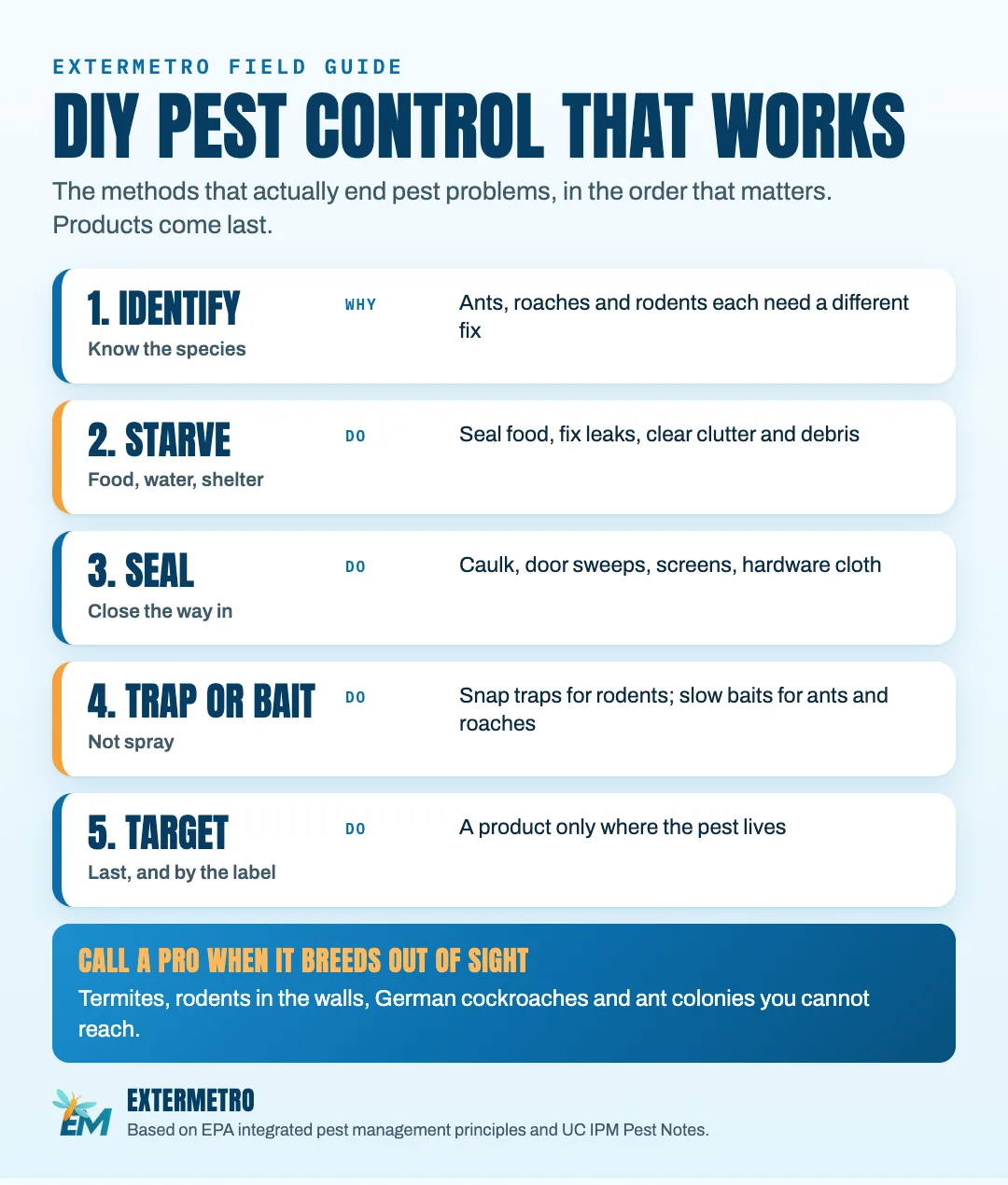
The best methods to get rid of household pests are, in order: identify the pest, take away its food, water and shelter, seal the way in, trap or bait instead of spraying, and use a targeted product only where it is needed. That order is integrated pest management, the approach the EPA and the University of California both recommend, and it is why the cheapest steps on this list beat the shelf of sprays.
- Identify the pest. The right fix depends on the species: Argentine ants, German cockroaches and roof rats each need something different.
- Take away food, water and shelter. Seal food, fix leaks and drips, clear clutter and yard debris, and keep plants and mulch off the walls.
- Seal the way in. Caulk cracks, add door sweeps, repair screens, and close rodent gaps with hardware cloth or sheet metal.
- Trap or bait instead of spraying. Snap traps for rodents; slow-acting baits for ants and cockroaches, which carry the dose back to the colony.
- Use a targeted product last, by the label. Apply a product only where the pest lives and follow the label exactly; foggers and broad sprays rarely help.
What actually has merit
- Diatomaceous earth (DE). This fine powder really can kill insects that walk through it by drying out their shell. It works in dry cracks and voids, loses its punch when damp, and does nothing to a colony you can't reach.
- Boric acid. Used as a slow-acting bait, or for cockroaches as a thin film of dust in dry, undisturbed cracks and voids — never piled or sprinkled in the open — boric acid genuinely works on cockroaches and some ants over time. The catch is using it correctly and keeping it away from children and pets.
- Sealing and sanitation. The most effective “natural” pest control isn't a product at all: caulk the gaps, fix the leaks, store food sealed and clear the clutter. That prevents far more than any spray.
Shopping for products labeled organic or natural? Our guide to organic pest control explains what those words mean under USDA, EPA and California rules.
What mostly disappoints
- Vinegar. Wiping an ant trail with vinegar erases the scent trail and stops the ants you see, but it doesn't kill the colony, so more ants soon follow. UC IPM suggests soapy water for the same cleanup, then a slow-acting bait outdoors near the trail and caulk where they enter.
- Essential oils (peppermint and the like). They can briefly deter ants or spiders right where you apply them, but the effect fades fast and won't clear an infestation.
- Bleach on ants. It kills the ants it touches and cleans the trail, but the nest outside keeps sending more.
- Cinnamon, coffee grounds and cucumber peels. Popular online, but there's no real evidence these repel pests in a way that matters.
- Ultrasonic repellers. Despite the marketing, there's no reliable evidence these plug-in devices clear a pest problem.
DIY pest control by pest: what works and when to call
Do-it-yourself pest control works best on pests you can reach and starve, and worst on anything breeding inside walls, soil or wood. Here is the line for each common household pest.
| Pest | What works yourself | Call a pro when | Read more |
|---|---|---|---|
| Ants | Wipe the trail, then a slow sweet bait outdoors on the trail, then caulk (UC IPM) | They return after two rounds or nest in a wall | Ants |
| German cockroaches | Gel bait in small dabs in cracks, thin boric acid dust in voids, sealed food; no foggers (UC IPM) | You see them in daylight or they keep breeding in the kitchen | German roaches |
| Outdoor cockroaches | Door sweeps, weather stripping, sealed gaps and drier drains | They come in every week | Turkestan roaches |
| Spiders | Vacuum spiders and webs, seal cracks, cut clutter, keep lights off the house (UC IPM) | Black widows keep returning near kids or pets | Black widows |
| Rats and mice | Snap traps along runways while you seal every gap 1/4 inch and larger (UC IPM) | They are in the attic or walls, or the roofline needs work | Rats and mice |
| Fleas | Vacuum daily or every other day, wash pet bedding weekly in hot soapy water, treat pets with a vet-recommended product (UC IPM) | Bites continue after two or three weeks | Fleas |
| Gnats and small flies | Find and remove the breeding site; tape over drains to find it | A drain you cannot reach, or phorid flies from a slab | Gnats |
| Pantry pests | Throw out infested food, clean shelves, store food in containers with tight lids; insecticides are not recommended (UC IPM) | They keep appearing after a full cleanout | Pantry pests |
| Termites | Nothing reliable; UC IPM does not recommend do-it-yourself treatment for drywood termites | Always, for a termite inspection | DIY termite treatment |
When DIY isn't enough
DIY can handle a few stray ants or a one-off spider. It struggles with anything that breeds out of sight or comes from a colony — Argentine ant supercolonies, German cockroaches, rodents in the walls, and especially termites, which DIY essentially can't reach. Our DIY-vs-pro guide walks through where that line is.
If you've tried the reasonable home steps and the problem keeps coming back, that's the signal the source is somewhere you can't get to. Ask for a free quote and we'll find it.
Sources
- EPA: Minimum Risk Pesticides Exempted from FIFRA Registration
- EPA: Do's and Don'ts of Pest Control
- UC IPM Pest Notes: Drywood Termites (University of California)
- UC IPM Pest Notes: Ants (University of California)
- UC IPM Pest Notes: Cockroaches (University of California)
- EPA: Integrated Pest Management (IPM) Principles
- UC IPM: What Is Integrated Pest Management?
- UC IPM Pest Notes: Spiders (University of California)
- UC IPM Pest Notes: Fleas (University of California)
- UC IPM Pest Notes: Pantry Pests (University of California)
- UC IPM Pest Notes: Rats (University of California)
- National Pesticide Information Center: Diatomaceous Earth General Fact Sheet
When DIY stops, route by the evidence.
Termite colonies are not a spray-and-wait problem. Pellets below wood, mud tubes on the foundation, and unexplained wings each point to a different next step. Start with the clue instead of guessing at a treatment.
Have a photo? Text it for a free quote.
Not termites? The same rule applies to anything breeding out of sight — the colony is the target, not the trail.
Quick Answers
Quick Answers.
How effective is DIY pest control?
It depends on what you are fighting. Sealing and sanitation, diatomaceous earth in dry cracks, and boric-acid baits used correctly genuinely work on the pests you can reach. Vinegar, essential oils, bleach, coffee grounds and ultrasonic devices mostly stop what you can see without touching the colony. Anything breeding out of sight — termites, rodents in the walls, Argentine ant supercolonies, German cockroaches — is usually beyond DIY.
Does vinegar get rid of ants?
Vinegar wipes out the scent trail and stops the ants currently marching, but it doesn't kill the colony outside, so more ants keep coming. UC IPM suggests soapy water or window cleaner for the same cleanup, then a slow-acting bait outdoors near the trail and caulk where they enter. It's a cleanup, not a cure.
Does diatomaceous earth really work?
Yes, within limits. DE kills insects that crawl through it by drying out their shell, so it helps in dry cracks and voids. It stops working when damp and can't reach a colony hidden in a wall or the soil.
Do peppermint oil and other essential oils repel pests?
They can briefly deter ants or spiders right where you apply them, but the effect fades quickly and won't clear an actual infestation. They're a mild, short-term deterrent at best.
Is boric acid effective for roaches?
Yes, used correctly, though slowly. UC IPM says boric acid works as a thin film of dust in dry, undisturbed cracks and voids, where it clings to a cockroach's body and is swallowed when the roach grooms itself; it is not repellent, but thick layers cake and clump, and deposits that get wet and cake are not picked up readily. Expect 7 days or more before a significant effect on the population. Keep it away from children and pets, and do not use it outdoors, where UC IPM notes it is toxic to plants.
When should I stop DIY and call a pro?
When the problem keeps coming back, comes from a colony or nest you can't reach, or involves termites or rodents in the structure. Those breed out of sight, and DIY rarely reaches the source.
Can I get rid of termites myself?
No, and this is the one where do-it-yourself reliably costs more than it saves. Shelf products reach the surface of the wood, while a drywood colony lives in sealed galleries inside it and a subterranean colony lives in the soil, with only the workers traveling up into your framing. UC IPM says do-it-yourself treatments are not recommended for drywood termites, the products needed to control them are not available for homeowner use, and home-use products are not effective. Spraying what you can see kills foragers and leaves the colony intact, and sweeping up the pellets, knocking down the tubes and patching the kickout holes removes the evidence an inspector reads to locate the activity. California's licensing law exempts owners treating their own property, but anyone you hire to inspect or treat for termites must be licensed by the Structural Pest Control Board. What you can do yourself is the prevention side, so fix leaks, break earth-to-wood contact and keep firewood off the ground.
Does borax kill ants and roaches?
Borax and boric acid work, but only used the right way and only if you are patient. For ants, UC IPM says a bait must be slow-acting so workers carry it back to the nest before they die, and it recommends liquid borate baits of 0.5 to 1 percent borate in sugar water, in refillable bait stations, for severe Argentine ant infestations. For cockroaches, boric acid works as a thin film of dust in dry, undisturbed voids, where it clings to their bodies and they swallow it while grooming; thick piles cake and clump, and dust that gets wet and cakes is not picked up readily. Keep it away from children and pets. It will not reach termites, which feed inside wood and travel through soil and mud tubes instead of foraging in the open the way ants and roaches do.
Does baking soda kill roaches?
No. The popular version of this one says roaches eat baking soda mixed with sugar and it reacts inside them. There is no good evidence for it, and it is not how roach control works. Roaches are cleared with gel baits they actually feed on, growth regulators that stop the next generation, and treatment of the cracks and voids where they harbor. Baking soda is a fine deodorizer for the cabinet you just cleaned out. It is not a treatment.
What is the best DIY pest control?
Sealing and starving the pest, then trapping or baiting it. Caulk, door sweeps, hardware cloth, fixed leaks and sealed food prevent more problems than any spray, and snap traps for rodents and slow-acting baits for ants and roaches handle what is already inside.
What are the best methods to get rid of household pests?
In order: identify the pest, take away its food, water and shelter, seal the way in, trap or bait instead of spraying, and use a targeted product only where the pest lives, by the label. That is integrated pest management, the approach the EPA and the University of California recommend.
Is DIY pest control cheaper than hiring a pro?
For a few stray ants or a spider, yes. For pests that breed out of sight, repeated store products often cost more than one visit that finds the source. Our one-time visit prices near Arcadia are published on our pest control cost page.
What pests can I handle myself?
Stray ants, a spider or two, fruit flies and gnats, pantry moths and the occasional outdoor roach are all realistic do-it-yourself jobs. German cockroaches breeding in a kitchen, rodents in the attic and anything involving termites usually are not.
Do bug bombs and foggers work?
Not well. UC IPM advises against foggers, bombs and aerosol sprays for cockroaches because they can be hazardous and may repel and scatter roaches to other areas without killing them, and it notes that spraying ants indoors will not stop more ants from coming in. Gel baits in cracks, a thin film of boric acid dust in voids and sealing the entry points do far more.
How long do ant and roach baits take to work?
Expect about a week, not a day. UC IPM says it can take 5 to 10 days to see fewer ants after baiting and 7 days or longer to see fewer cockroaches with gel baits or bait stations, and boric acid dust may take 7 days or more. Keep wiping up ant trails in the meantime, replace baits when they are empty, and move the bait or try a different product if the ants are not taking it.
Keep Reading
About the Author
Joshua A. Westad is the owner and licensed operator of ExterMetro Termite and Pest Control in Arcadia, CA. He holds California SPCB Company Registration #8828 (Branch 2 & 3), is a licensed WDO inspector, and has worked San Gabriel Valley homes and businesses for over twelve years — hands-on in the field on every kind of job the valley throws at him.
Tried the home remedies and it keeps coming back?
That is the signal the source is somewhere you cannot reach. Free quotes, honest answers, and licensed service that follows through.