

Organic Pest Control: What “Organic” Really Means, and What Works in a Home
“Organic,” “natural” and “green” get stamped on a lot of pest control. Only one of those words has a legal definition, and it was written for farms. Here is what each one tells you, and what works in a house.
“Organic” has one firm meaning for pesticides: products that meet the USDA National Organic Program standard, which covers food, fiber and the materials used to grow them, inert ingredients included. That standard does not certify a pest control service in a house, so a company calling itself organic can mean almost anything. What is defined: EPA-registered biopesticides made from plants, bacteria or certain minerals, and “minimum risk” products that EPA exempts from registration without reviewing them, which California also regulates. Natural is not the same as nontoxic; some plant extracts are as toxic as synthetic pesticides or more so. The lowest-toxicity pest control that works is integrated pest management: seal, clean up, trap, and place baits only where pests feed. Ask any company for the product and its active ingredient in writing, which California law already requires.
Local help: We favor baits, targeted placements, traps and sealing over blanket spraying, and we name every product in writing before we apply it. Call or text (626) 409-1584.
On this page
- What “organic pest control” actually means
- Organic, natural, “green,” minimum risk: what each label tells you
- Minimum risk (25(b)) products: exempt, not reviewed
- Natural is not the same as nontoxic
- Lower-toxicity pest control that works, pest by pest
- How we keep product use low
- Questions to ask a company that sells organic pest control
- Sources
- Quick answers
What “organic pest control” actually means
Organic pest control, in the strict sense, means using products allowed under the USDA organic standard. The National Organic Program writes and enforces that standard for agricultural products sold in the United States and accredits the certifiers who check farms and food businesses. For a pesticide, NPIC explains, “organic” means a product with no prohibited synthetic chemicals, and even its “inert” or “other” ingredients have to qualify. The Organic Materials Review Institute (OMRI), an independent reviewer, checks products against that standard and lists the ones that pass.
That standard was built for growing food and fiber. It does not certify a pest control service in a house, so when a company advertises organic pest control it can mean OMRI-listed products, plant oils, or nothing in particular. The useful question is not whether a company is organic. It is which product it will use, where it will put it, and why.
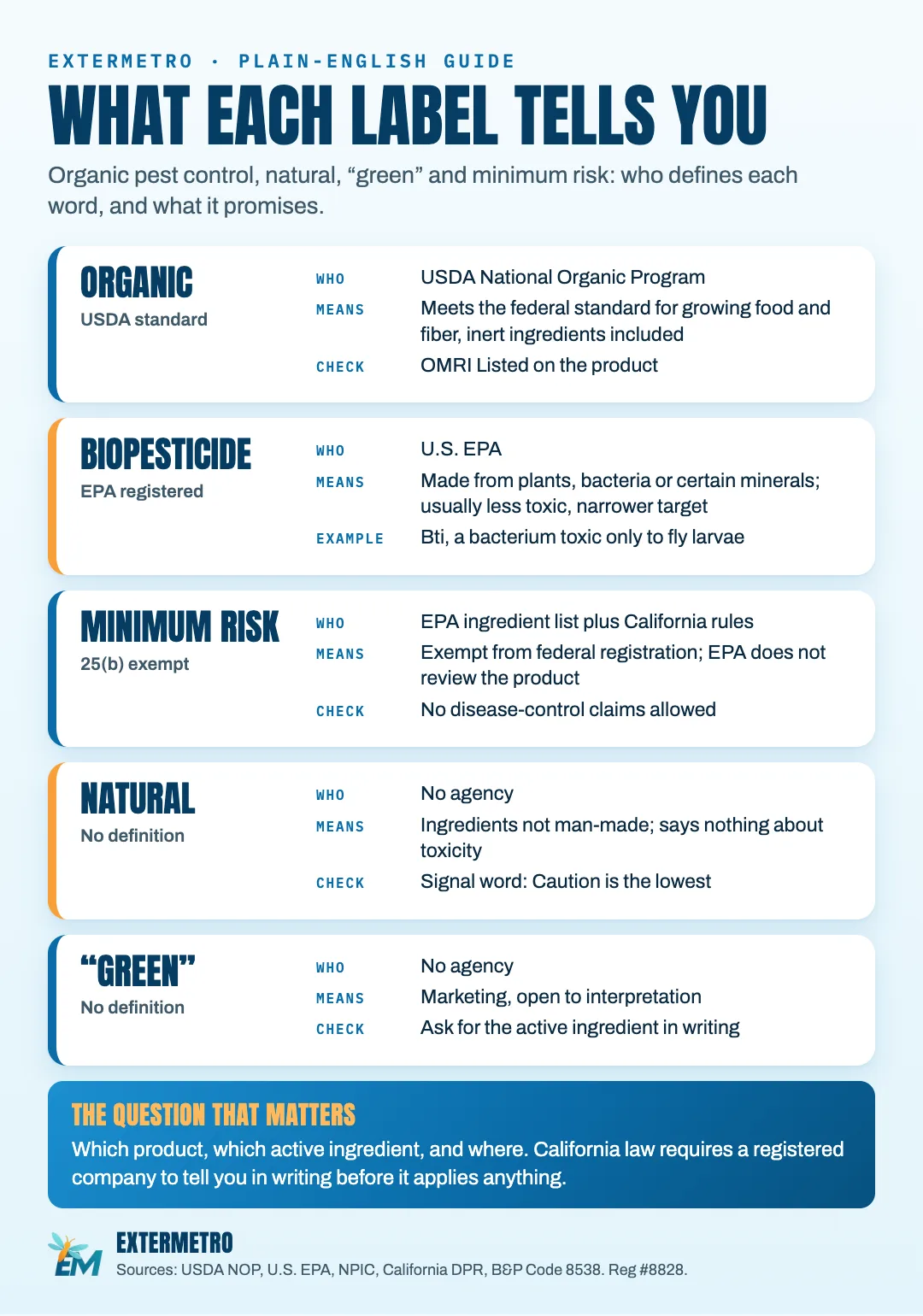
Organic, natural, “green,” minimum risk: what each label tells you
Only some of the words on a pest control label or ad are defined by anyone. Here is who stands behind each one.
| Label | Who defines it | What it tells you |
|---|---|---|
| Organic | USDA National Organic Program | Meets the federal organic standard for food and fiber production, inert ingredients included (NPIC) |
| OMRI Listed | Organic Materials Review Institute, an independent reviewer | The product was reviewed against the USDA organic standard and listed (NPIC) |
| Biopesticide | U.S. EPA | A registered pesticide made from natural materials such as plants, bacteria or certain minerals; EPA says these are usually inherently less toxic than conventional pesticides and generally affect only the target pest |
| Minimum risk, or 25(b) | U.S. EPA ingredient list, plus California’s own conditions | Exempt from federal registration because every ingredient is on EPA’s list; EPA does not review the product itself |
| Natural | No agency | The ingredients are not man-made; it says nothing about toxicity (NPIC) |
| “Green” or “nontoxic” | No agency | Marketing; EPA does not allow these claims on a registered pesticide’s label (NPIC) |
| Signal word “Caution” | The product label, under EPA rules | The lowest hazard level a pesticide label can carry (NPIC) |
Minimum risk (25(b)) products: exempt, not reviewed
Many shelf products sold as natural pest control are minimum risk products, also called 25(b) products after the section of federal pesticide law that exempts them. To qualify, every active ingredient has to be on a short list in federal regulations: cedarwood, cinnamon, clove, citronella, peppermint, rosemary and thyme oils, garlic and a short list of others. Every ingredient has to be printed on the label.
- EPA does not review them. Because the products are exempt, EPA says it does not review them, and a label implying EPA approval is misleading.
- No disease claims. A minimum risk label may say it controls mosquitoes or ticks, but not that it protects you from West Nile virus or Lyme disease.
- California adds its own rules. A product has to meet the state’s conditions as well as EPA’s, or be registered with the Department of Pesticide Regulation. Where the two differ, California’s criteria win.
- A license is still required. DPR notes these products are still pesticides, and anyone applying them for hire is still subject to state licensing.
Registration is the step that tests whether a product works. California evaluates every registered pesticide for efficacy and potential harm before it can be sold or used here. An exempt product skips that review. That does not make it useless, but nobody checked the claim on the bottle.
Natural is not the same as nontoxic
“Natural” only means the ingredients were not made in a lab. NPIC, the National Pesticide Information Center at Oregon State University, puts it plainly: plant oils are sometimes low in toxicity, but some plant extracts are just as toxic as similar synthetic pesticides, or more so. It also points out that some of the most toxic substances known, arsenic and ricin among them, are natural.
The reverse holds too. Plant oils such as peppermint, rosemary and clove do kill ants on contact, but UC IPM notes they have limited residual activity. They stop the ants you hit, not the colony. California prints the bottom line on the notice every registered pest control company must give you before it applies anything: “Caution—pesticides are toxic chemicals.” Every product, natural or not, works by being toxic to something. What you can control is how much is used, and where.
Lower-toxicity pest control that works, pest by pest
The lowest-toxicity pest control that works is not a product. It is integrated pest management: identify the pest, take away its food, water and shelter, seal the way in, and use a targeted product only where it is needed. Here is what that looks like for the pests we see most in the San Gabriel Valley.
| Pest | What works with the least product | The catch |
|---|---|---|
| Argentine ants | Slow-acting baits near trails and nest openings outdoors; liquid borate baits (0.5 to 1 percent borate in sugar water) in refillable stations for heavy infestations; caulk where they enter (UC IPM) | Sprays give only temporary control; UC IPM advises asking a company for baits and spot treatments rather than perimeter treatments or monthly sprays |
| German cockroaches | Gel baits in cracks; boric acid or desiccant dusts such as diatomaceous earth and silica aerogel in wall voids and under appliances; cut off food and water (UC IPM) | Dusts work only while they stay dry and undisturbed; sprays do not give long-term control |
| Rats and mice | Snap traps and sealing, done at the same time; no poison needed to clear a house | Trapping alone leaves the openings; sealing alone shuts rats inside |
| Fungus gnats | Let potting soil dry out; Bti, a naturally occurring bacterium, applied to the soil at label rates (UC IPM) | Bti gives temporary control and is toxic only to fly larvae, so repeat applications are common |
| Mosquitoes | Dump standing water every week; Bti products made for water you cannot dump | Not an ExterMetro service: the San Gabriel Valley Mosquito and Vector Control District handles mosquito problems, (626) 814-9466 |
| Spiders | Vacuum webs and egg sacs, seal cracks, cut clutter, and keep lights off the house (UC IPM) | Black widows that keep coming back near children or pets are worth a visit |
| Drywood termites | No natural product reliably clears a colony; orange oil kills only the termites it touches | Termite work in California needs a licensed Branch 3 company; start with an inspection |
For home remedies that do not need a label at all, our guide to natural and DIY pest control rates vinegar, essential oils, diatomaceous earth and the rest.
How we keep product use low
We do not sell a separate “organic” service, because the word has no certification for pest control in a house. We use the approach UC IPM and the EPA recommend, which keeps product use low by design:
- Baits and targeted placements in cracks, voids and tamper-resistant stations, instead of blanket spraying the rooms your family uses.
- Trap and seal at the same time for rats and mice, so the house is cleared without relying on poison.
- Every product applied to its label and named for you in writing before we apply it, with its active ingredient, as California law requires.
- A straight answer when no product is needed. Fungus gnats from an overwatered houseplant need drier soil, not a pest control visit, and we will tell you so.
More on how we handle treatments around children and pets is in our low-impact approach.
Questions to ask a company that sells organic pest control
These questions turn an “organic” sales pitch into something you can check.
| Ask | Why it matters |
|---|---|
| Which product will you use, and what is its active ingredient? | A registered California company has to give you this in writing before it applies anything (Business and Professions Code 8538) |
| Is it a registered pesticide, a biopesticide, or a 25(b) minimum risk product? | Registered products have been evaluated in California for efficacy and potential harm; minimum risk products have not been reviewed by EPA |
| If you call it organic, is it OMRI listed? | That is the independent check against the USDA organic standard |
| What is the signal word on the label? | “Caution” is the lowest hazard level a pesticide label can carry |
| What is the nonchemical part of the plan? | Sealing, sanitation and traps do more than any product, natural or not |
| Are you licensed? | Applying even exempt products for hire is subject to state licensing; look the company up in two minutes |
Our guide to choosing a pest control company covers the rest of the checklist: licenses, inspections, quotes and red flags.
Sources
- USDA Agricultural Marketing Service: National Organic Program
- National Pesticide Information Center: Pesticide Quick FAQs (organic and natural products)
- National Pesticide Information Center: “Natural or Green?” What does it mean?
- EPA: What Are Biopesticides?
- EPA: Conditions for Minimum Risk Pesticides
- 40 CFR 152.25(f): active ingredients permitted in minimum risk pesticide products
- California Department of Pesticide Regulation: Section 25(b) Pesticide Products Exempt From Registration
- California Department of Pesticide Regulation: How to Register a Pesticide
- UC IPM Pest Notes: Ants (University of California)
- UC IPM Pest Notes: Cockroaches (University of California)
- UC IPM Pest Notes: Fungus Gnats (University of California)
- UC IPM Pest Notes: Spiders (University of California)
- UC IPM: What Is Integrated Pest Management?
- California Structural Pest Control Act, Business and Professions Code 8538 (pesticide notice)
Common Questions
Quick Answers.
What is organic pest control?
Strictly, pest control that uses products allowed under the USDA National Organic Program standard, often checked and listed by the Organic Materials Review Institute (OMRI). More loosely, companies use it for plant-based or naturally derived products. The USDA standard does not certify a pest control service in a house, so ask which product and active ingredient a company will use.
Is organic pest control effective?
It depends on the product and the pest. Some lower-toxicity methods work well: borate baits for ants, gel baits and desiccant dusts for cockroaches, Bti for fungus gnat and mosquito larvae, and trapping plus sealing for rodents. Plant oil sprays kill on contact but have limited residual activity. Minimum risk 25(b) products are exempt from EPA review, so nobody has checked the claim on the label.
Are natural pesticides less toxic than synthetic ones?
Sometimes, but not always. The National Pesticide Information Center notes that plant oils are sometimes low in toxicity, while some plant extracts are just as toxic as similar synthetic pesticides, or more so. Check the signal word on the label: Caution is the lowest hazard level.
Is organic pest control better around kids and pets?
Not automatically, because organic and natural do not mean nontoxic. What matters more is how the product is placed: baits and crack-and-void placements instead of broad spraying, applied exactly to label, with any re-entry time explained before the work starts.
What does OMRI Listed mean?
It means the Organic Materials Review Institute, an independent reviewer, has checked the product against the USDA organic standard and listed it. It tells you the product fits the organic rules. It does not mean the product is risk-free; the National Pesticide Information Center notes that an organic pesticide still carries some risk.
What are minimum risk or 25(b) pesticides?
Products made only from ingredients on an EPA list, such as cedarwood, clove, peppermint, rosemary and thyme oils, with every ingredient printed on the label. They are exempt from federal registration and EPA does not review them. They cannot claim to control disease-carrying pests, and in California they must also meet state conditions or be registered with the Department of Pesticide Regulation.
Is there certified organic pest control for homes?
No government program certifies a home pest control service as organic. The USDA organic standard covers agricultural products such as food and fiber. A company can choose OMRI-listed or minimum risk products, but it still needs a state license to apply them for hire.
Does ExterMetro offer organic pest control?
We do not sell a separate organic service, because the word has no certification for pest control in a house. We keep product use low by design: baits and targeted placements instead of blanket spraying, trapping and sealing at the same time for rodents, every product applied to label, and the product and its active ingredient named in writing before we apply it.
Keep Reading
About the Author
Joshua A. Westad is the owner and licensed operator of ExterMetro Termite and Pest Control in Arcadia, CA. He holds California SPCB Company Registration #8828 (Branch 2 & 3), is a licensed WDO inspector, and has worked San Gabriel Valley homes and businesses for over twelve years — hands-on in the field on every kind of job the valley throws at him.
Think you just found termite evidence?
Bag a few wings or pellets, snap a photo, and text it to (626) 409-1584 — quotes from photos are free, and your job stays under licensed ExterMetro oversight from inspection through follow-up.